Silvopasture: Growing Forage Under Trees Without Killing Either
Somebody told you trees and livestock don’t mix. Less grass, more shade, slower gains — a tradeoff you couldn’t afford. That’s the conventional wisdom, and it’s wrong when the system is designed right.
A well-set silvopasture produces more total value per acre than either trees or pasture alone. Shade reduces heat stress and cuts water demand in your forage. Trees generate a long-term timber or nut crop on ground that’s also producing beef or lamb. The right combination, and the ground is doing two jobs instead of one.
Two decisions drive everything: which tree species fits your goals and region, and which forage species holds production under partial canopy. Get those right. Everything else is management.
Three Ways to Set It Up
Three basic configurations. Which one you start with depends on what’s already on your ground.
Plant trees into existing pasture
Most common for small operations. Establish rows of trees across your existing pasture at wide spacing — 30 to 60 feet between rows — and manage the alleys as normal pasture. Tree density stays low enough that ground-level light supports forage production for years while you wait for the timber value to build.
Establish forage under existing trees
Common on farms with existing woodland or established shelterbelts. Clear understory brush, open up canopy where needed, and put shade-tolerant forage species into the openings. Cheaper than planting new trees and faster to produce a result — you’re working with what’s already there.
Thin a woodlot and seed the openings
Take an existing woodlot, thin it to 40–60% canopy cover, and establish forage in the openings. Most complex approach. Most potential for existing forested ground that’s currently producing nothing but hunting.
Picking the Right Tree
The right tree depends on your goals, region, and what markets are available to you. Here’s how the main categories compare. [2]
| Tree Category | Best Species | Primary Value | Forage Compatible? | Notes |
|---|---|---|---|---|
| Timber | Black locust | Fast-growing, rot-resistant wood; fixes nitrogen | Excellent — no allelopathy | Best all-around silvopasture tree in the humid East |
| Timber | Black walnut | Premium timber value | Moderate — allelopathic to some species | Keep grass rows 10–12 ft from trunk; tall fescue tolerates it best |
| Nut crop | Chestnut | Annual nut harvest; fast-growing | Excellent — no allelopathy | Nuts supplement livestock feed; widely adaptable |
| Fodder tree | Mulberry | Leaf harvest 15–20% crude protein [1] — comparable to alfalfa | Good | Coppice every 2–3 years for continuous leaf production |
Forage Under Canopy: Most Species Won’t Cut It
This is where most silvopasture forage plantings fall apart. The wrong species goes in, trees fill in, and production collapses just as the system is starting to look like something. Pick species that are built for partial shade — not ones that need full sun.
| Species | Shade Tolerance | Minimum Light Needed | Products We Offer |
|---|---|---|---|
| Orchardgrass | Excellent | ~40% of full sun | Orchardgrass |
| White clover | Good | ~45% of full sun | White Dutch Clover |
| Tall fescue | Good | ~45% of full sun | Tall Fescue |
| Timothy | Moderate | ~50% of full sun | Timothy |
| Alfalfa | Poor — avoid | 65%+ required | Alfalfa |
| Bermudagrass | Poor — avoid | 65%+ required | Bermudagrass |
Nature’s Seed carries: Orchardgrass (naturesseed.com/products/pasture-seed/orchardgrass/), White clover (naturesseed.com/products/clover-seed/white-dutch-clover/), Tall fescue (naturesseed.com/products/pasture-seed/tall-fescue/), Timothy (naturesseed.com/products/pasture-seed/timothy/), Alfalfa (naturesseed.com/products/pasture-seed/alfalfa/), and Bermudagrass (naturesseed.com/products/pasture-seed/bermudagrass/).
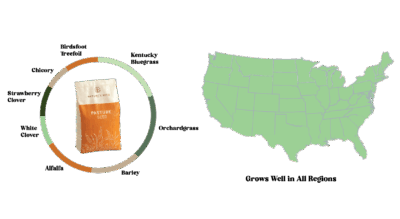
Orchardgrass is the standout. It was literally named for its original habitat — orchards — and its shade tolerance reflects that history. Productive, palatable, and persistent under 30–50% canopy cover. If you plant one thing in your tree alleys, that’s it.
Protecting Young Trees — This Is Where Most Attempts Fail
Years one through five. Young trees are defenseless. Cattle rub, browse, and girdle a sapling in a single grazing event — and a tree you’ve been growing for three years disappears in an afternoon. You need a plan before you plant.
- Tree tubes: plastic tubes protect the trunk and speed early growth. Cost $3–6 per tree. Good for 3–5 years before the tree outgrows them.
- Wire cages: 4–5 feet of hardware cloth or cattle panel formed into a cylinder. More durable than tubes and better if you’re running sheep or goats — they browse harder. Cost $8–15 per tree.
- Electric fence exclusion: fence off entire tree rows until trunks reach 3-inch diameter and can handle contact. Higher upfront cost, fully flexible and reusable when you’re done.
EQIP Pays for a Big Chunk of This
Silvopasture is explicitly supported under USDA EQIP cost-sharing. Payments vary by state but can offset 50–75% of your tree establishment costs. Your local NRCS office gets you started.
That cost-share changes the math. A practice that looks marginal at full cost often pencils out clearly when you’re covering 25–50% of establishment. Apply early — funds are limited and allocated competitively each year. This is free money most small landowners never ask about.
→ Nature’s Seed covers the forage layer of any silvopasture system. For the shaded alleys between tree rows, Orchardgrass is your anchor species — shade-tolerant, persistent, and highly productive under 30–50% canopy cover: naturesseed.com/products/pasture-seed/orchardgrass/. Pair it with White Dutch Clover for ground cover and nitrogen: naturesseed.com/products/clover-seed/white-dutch-clover/. For a complete multi-species perennial sward, browse regional livestock pasture mixes: naturesseed.com/products/pasture-seed/
The tree half of silvopasture — black locust, chestnut, mulberry, honey locust, hybrid poplar — comes from state nurseries, conservation district cost-share programs, and specialty tree nurseries, not seed companies. Your local NRCS office can connect you with EQIP cost-share for tree establishment.
References
- USDA National Agroforestry Center. (2019). Silvopasture: An agroforestry practice. https://www.fs.usda.gov/nac/practices/silvopasture.php
- Nair, P. K. R. (1993). An introduction to agroforestry. Kluwer Academic Publishers.
Part of our Regenerative Agriculture series — explore the full guide to find the right seeds and practices for your land.