Multi-Species Cover Crop Mixes Explained: Why Single Species Are Leaving Performance on the Table
You’ve been putting straight winter rye in the ground for four years. Ground looks better, no question. But the improvements have leveled off — organic matter barely moved this season, same thin spots in the same low corners, weed pressure not much different from year three.
That plateau is what a single species does. Rye is reliable, cheap, and worth growing. It’s also leaving performance on the table because it does one thing — and your soil needs more than one thing done.
Multi-species mixes consistently outperform single-species plantings on biomass, weed suppression, nitrogen contribution, and soil biology [2]. Not theoretical — documented across soil types and climates. Here’s how to build one.
The Four Functional Groups — What Each Is Actually Doing
Different species do different jobs in your ground. A well-designed mix covers multiple functions in one planting. Here’s how to think about each group and what to put in the drill. [1]
| Group | Function | Best Species | Monoculture Rate | In-Mix Rate | Products We Offer | Other Seeds That Can Help |
|---|---|---|---|---|---|---|
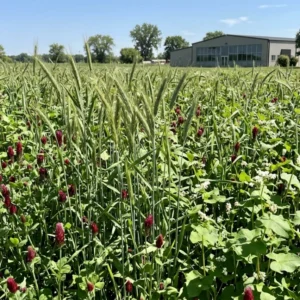
| Grasses | Biomass, OM, weed suppression | Winter rye, oats | Rye: 90 lbs/ac drilled | Rye: 40–50 lbs/ac | Cereal Rye | Oats: farm co-ops and cover crop specialty suppliers |
| Legumes | N-fixation — 60–120 lbs N/ac [1] | Hairy vetch, crimson clover | Vetch: 20 lbs/ac | Vetch: 10–12 lbs/ac | Crimson Clover | Hairy vetch: farm co-ops and cover crop specialty suppliers |
| Brassicas | Compaction breaking, nutrient scavenging from depth | Daikon radish, turnip | Radish: 8 lbs/ac | Radish: 3–4 lbs/ac | Soil Builder Cover Crop Kit | Daikon radish and turnip as standalone species: other seed suppliers |
| Broadleaf non-legumes | Root exudate diversity; pollinator benefit | Phacelia, buckwheat, sunflower | Variable | 1–3 lbs/ac | Buckwheat | Phacelia and sunflower: other seed suppliers |
Nature’s Seed carries from this table: Winter rye (naturesseed.com/products/pasture-seed/cereal-rye/), Oats (naturesseed.com/pasture-seed/individual-pasture-species/oats/), Crimson clover (naturesseed.com/products/pasture-seed/crimson-clover/), Buckwheat (naturesseed.com/products/pasture-seed/common-buckwheat/), and the Soil Builder Cover Crop Kit (naturesseed.com/products/pasture-seed/soil-builder-cover-crop-kit/) which includes mustard for compaction breaking. Hairy vetch is not currently in our catalog — source from your local co-op or specialty cover crop supplier. For daikon radish, turnip, phacelia, and sunflower, check your local co-op or specialty cover crop supplier.
When building a mix, cut each species rate 30–50% from its monoculture rate. The total mix cost often comes out close to a high-rate monoculture — you’re just buying five SKUs instead of one and putting more function in the ground.
Recipes Built Around a Single Goal
Start with what your field needs most, then build the mix around that. These aren’t invented — they’re field-tested.
| Goal | Products We Offer | Other Seeds That Can Help | Total Rate (incl. add-ons) | Notes |
|---|---|---|---|---|
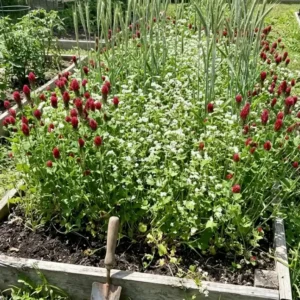
| Nitrogen for next crop | Cereal Rye / Crimson Clover | + Hairy vetch 15 lbs from farm co-op or specialty supplier | 63 lbs/ac | Grass component protects legume biomass from early breakdown; hairy vetch not carried by NS |
| Max biomass / organic matter | Cereal Rye / Soil Builder Cover Crop Kit | + Hairy vetch 12 lbs from farm co-op + Daikon radish 4 lbs from other supplier (optional) | 96 lbs/ac | Let stand reach full biomass; terminate before seed set. NS Soil Builder Kit includes mustard for a similar function if daikon is unavailable. |
| Grazing / forage cover | Crimson Clover | + Field peas 30 lbs from other supplier + Turnip 3 lbs from other supplier | 93 lbs/ac | All highly palatable; graze at 8–12 inch height. Field peas and turnip not carried by NS — check local co-op or specialty cover crop supplier. |
| Soil biology recovery | Cereal Rye / Crimson Clover / Buckwheat | + Hairy vetch 12 lbs from farm co-op + Daikon radish 4 lbs from other supplier + Phacelia 2 lbs from specialty supplier | 61 lbs/ac | Prioritize diversity over rates; lower total cost. Hairy vetch, daikon, and phacelia not sold by NS — check specialty cover crop suppliers. |
Nature’s Seed ingredients in these recipes: Winter rye (naturesseed.com/products/pasture-seed/cereal-rye/), Oats (naturesseed.com/pasture-seed/individual-pasture-species/oats/), Crimson clover (naturesseed.com/products/pasture-seed/crimson-clover/), Buckwheat (naturesseed.com/products/pasture-seed/common-buckwheat/). Hairy vetch, daikon radish, turnip, field peas, and phacelia are not sold by Nature’s Seed — source those from your local co-op or a specialty cover crop supplier.
Mistakes That Kill Mix Performance
- Skipping inoculant on legumes. Every legume needs specific Rhizobium bacteria to fix nitrogen. A hairy vetch plus crimson clover mix needs inoculant covering both species — or a separate inoculant for each. Without it, you’ve planted expensive green cover that doesn’t fix a pound of nitrogen.
- Not planning termination before you plant. Species in a mix don’t terminate on the same schedule. Rye at anthesis and immature clover respond differently to rolling. Know your method and your timing before the seed goes in the drill.
- Adding species for complexity, not function. Eight species can outperform five — but not reliably. Every species you add should be doing a job. If you can’t say what job it’s doing, cut it.
- Scaling up without a trial. Test new mixes on 5–10 acres before you put them on 80. Brassicas and legumes can compete hard in wet years; dominant grasses shade out small-seeded legumes when rates aren’t balanced. Find out on a small patch, not your whole cover crop budget.
→ Multi-species design is what our kits are built for. The Soil Builder Cover Crop Kit ships three functional groups — grass (cereal rye), legume (white clover), brassica (mustard biofumigant) — in separate bags so you can scale each independently: naturesseed.com/products/pasture-seed/soil-builder-cover-crop-kit/. For pollinator-driven 9-species diversity, the Honey Bee Cover Crop & Pasture Mix: naturesseed.com/products/pasture-seed/honey-bee-cover-crop-pasture-mix/. To build your own cocktail mix, combine Cereal Rye, Crimson Clover, and Buckwheat from our catalog as your foundation.
The species that round out a full cocktail mix that we don’t carry: hairy vetch, field peas, sorghum-sudangrass, sunn hemp, cowpeas, daikon radish, turnip, and forage collards. All are widely available at farm co-ops and cover crop specialty suppliers — add them by weight alongside the cereal rye and crimson clover from our catalog.
References
- Sustainable Agriculture Research & Education (SARE). (2012). Managing cover crops profitably (3rd ed.). https://www.sare.org/resources/managing-cover-crops-profitably-3rd-edition/
- Finney, D. M., & Kaye, J. P. (2017). Functional diversity in cover crop polycultures increases multifunctionality of an agricultural system. Journal of Applied Ecology, 54(2), 509–517. https://doi.org/10.1111/1365-2664.12765
Part of our Regenerative Agriculture series — explore the full guide to find the right seeds and practices for your land.