Cover Crops 101: How to Pick Your First Mix Without an Agronomy Degree
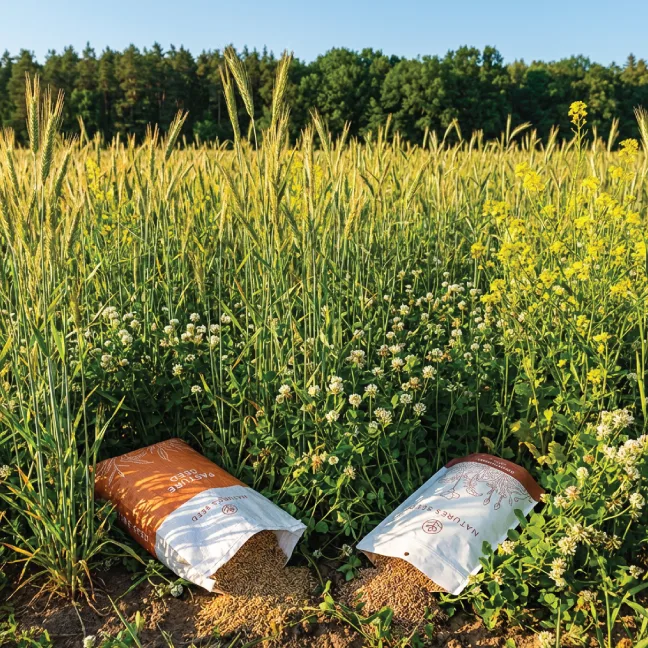
It’s late August and your field came off last week. Ground’s bare. You know you should be planting something — but every time you research cover crops you end up in a rabbit hole of seeding rate arguments and twelve-species cocktail mixes that look more like a PhD thesis than a farm plan.
That rabbit hole is the villain here. Overcomplicated advice keeps more cover crops from going in the ground than anything else. Three species, reasonable rate, terminate before it heads out — that improves your soil this season. Here’s how to build it.
A mix in the ground beats a perfect mix that never gets planted. Every time.
Why a Mix Beats Straight Rye
Most first-timers start with straight winter rye. Cheap, reliable, covers the ground. Not a bad start — but a diverse mix outperforms single-species plantings on almost every measure [2].
- More functions at once. Grasses lay down biomass and organic matter. Legumes fix nitrogen from the air. Brassicas break compaction. A three-species mix does all three in one planting — you’re not picking one benefit over another.
- Better soil biology. Different root architectures host different microbial communities. Five species supports a richer soil food web than one. That’s the biology you’re farming toward.
- Built-in insurance. One species struggles? The others carry the mix. Single-species stands are all-or-nothing when conditions go sideways.
Three to five well-chosen species is plenty. You don’t need twelve to see the return.
Three Functional Groups — What Each Does
| Group | What It Does | Best Species | Drilled Rate | Products We Offer | Other Seeds That Can Help |
|---|---|---|---|---|---|
| Grasses | Biomass, organic matter, weed suppression | Winter rye, oats | Rye: 60–90 lbs/ac; Oats: 60–80 lbs/ac | Cereal Rye | Oats: available at farm co-ops and cover crop specialty suppliers |
| Legumes | Fixes nitrogen — 60–120 lbs N/ac under good conditions [1] | Crimson clover, hairy vetch, field peas | Crimson: 15–20 lbs/ac; Vetch: 15–25 lbs/ac | Crimson Clover | Hairy vetch and field peas: farm co-ops and cover crop specialty suppliers |
| Brassicas | Deep taproot breaks compaction; scavenges nutrients from depth | Daikon radish, turnip | Radish: 5–8 lbs/ac; Turnip: 3–5 lbs/ac | Soil Builder Cover Crop Kit | Daikon radish and turnip as standalone species: other seed suppliers |
Nature’s Seed carries: Winter rye (naturesseed.com/products/pasture-seed/cereal-rye/), Oats (naturesseed.com/pasture-seed/individual-pasture-species/oats/), Crimson clover (naturesseed.com/products/pasture-seed/crimson-clover/). For hairy vetch, field peas, daikon radish, and turnip, check your local co-op or specialty cover crop supplier.
When mixing species, cut each individual rate by 30–40% from what you’d drill as a monoculture. Broadcasting into a standing crop? Bump total rates up 25–30% — you’ll get less soil contact and need to compensate.
Pick One Goal and Build Around It
Don’t just grab species at random. Figure out what your ground needs most, then build the mix around that.
- Smothering weeds: lead with high-biomass grasses. Rye and hairy vetch — the rye puts up a canopy fast, the vetch climbs and fills gaps.
- Building organic matter: stack the biomass. Oats plus winter rye plus turnip. You’re trying to put 4,000–5,000 lbs of dry matter on the ground.
- Putting nitrogen down for next crop: lead with legumes. Hairy vetch plus crimson clover plus winter rye. The rye holds the legume biomass intact so it doesn’t break down too fast.
- Grazeable forage cover: palatability is the priority. Oats plus field peas plus crimson clover. Your cattle will work it harder than anything else in this list.
Termination: Plan This Before You Plant
First-timers almost always wait too long. The cover sets seed, it’s harder to kill, and now you’ve got a volunteer rye problem in your cash crop. The rule is simple: terminate before seed set. Decide your method now, not when you’re watching it blow past the window.
- Mowing: cheap, works on clover and oats. Struggles with thick-stemmed mature rye — don’t rely on it if rye is your dominant species.
- Grazing: the best method when it fits your operation. Livestock do the work, drop nutrients, and you get a forage credit. Works well for mixes heavy in oats, field peas, and clovers.
- Rolling/crimping: no-till termination for organic systems. Has to be at anthesis or later to be effective — roll too early and it bounces back.
- Herbicide: fastest, most reliable. Glyphosate at label rate terminates most covers cleanly when timing is tight.
What to Avoid in Year One
- Overbuilding the mix. Three to five species is enough. An eight-species cocktail is impressive on paper — in practice you’re managing complexity that isn’t paying you back yet.
- Planting too late. Cool-season covers need 4–6 weeks before hard frost to do any good. Miss that window and you’re hoping for a miracle.
- Skipping inoculant on legumes. Legumes need specific Rhizobium bacteria to fix nitrogen. If you haven’t grown legumes in that field before, inoculate the seed. It’s a few dollars and it makes a real difference.
A Starter Mix That Works Without Overthinking It
First year? Here’s a simple three-species mix that covers the bases:
- Winter rye: 40 lbs/acre
- Crimson clover: 10 lbs/acre
- Daikon radish: 4 lbs/acre (not sold by Nature’s Seed — check your local co-op)
Put it in the drill in late summer or early fall. Inoculate the clover. Graze it or mow it before rye heads out in spring. The rye covers the ground and puts on biomass, the clover fixes nitrogen and bumps forage quality, the radish punches through compaction. That’s a full season of soil improvement from one uncomplicated planting.
→ For your first cover crop planting, Nature’s Seed makes it simple: the Soil Builder Cover Crop Kit gives you the three functional groups — grass, legume, brassica — in one order, shipped in separate bags. naturesseed.com/products/pasture-seed/soil-builder-cover-crop-kit/. Prefer to build your own mix? Start with Cereal Rye (naturesseed.com/products/pasture-seed/cereal-rye/) and Crimson Clover (naturesseed.com/products/pasture-seed/crimson-clover/) — two species that cover the basics for under $30/acre.
To round out a full cocktail mix, the species we don’t carry are hairy vetch, field peas, daikon radish, and turnip. All are widely available at farm co-ops and cover crop specialty suppliers — add them by weight alongside the cereal rye and crimson clover from our catalog.
References
- Sustainable Agriculture Research & Education (SARE). (2012). Managing cover crops profitably (3rd ed.). https://www.sare.org/resources/managing-cover-crops-profitably-3rd-edition/
- Blanco-Canqui, H., et al. (2015). Cover crops and ecosystem services: Insights from studies in temperate soils. Agronomy Journal, 107(6), 2449–2474. https://doi.org/10.2134/agronj15.0086
Part of our Regenerative Agriculture series — explore the full guide to find the right seeds and practices for your land.