
The Best Grass Seed For Georgia

Available Pasture Mixes for Georgia
- Big Game Food Plot & Forage Mix
- Chicken Forage Seed Mix
- Cool Season Cattle Pasture Seed Mix
- Full Potential Food Plot
- Goat Pasture & Forage Mix | Warm Season
- Green Screen Food Plot
- Honey Bee Cover Crop & Pasture Mix
- Horse Pasture Mix | Warm Season
- Krunch and Munch Food Plot
- Llama & Alpaca Pasture Seed Mix
- Pig Pasture & Forage Mix
- Plains Prairie Mix
- Sandhills Prairie Mix
- Shade Mix Food Plot
- Sheep Pasture & Forage Mix | Warm Season
- Shortgrass Prairie Mix
- Tortoise Forage & Habitat Mix
- Warm Season Cattle Pasture Seed Mix
Pasture Grass Species for Georgia
Clover Seed for Georgia

Specialty Seed for Georgia

Wildflower Seed for Georgia
Selecting the Best Georgia Grass Seed for a Lush Lawn
What is the best grass seed to plant in Georgia? The best grass seed for Georgia depends heavily on your location’s USDA plant hardiness zone. Northern Georgia (zones 6a-7a) is considered a transition zone, supporting both cool-season grasses like Tall Fescue and Kentucky Bluegrass, and warm-season grasses like Bermuda Grass. Southern Georgia (zones 8a-9a) benefits most from heat and drought-tolerant warm-season types such as Bermuda, Zoysia, and Centipede Grass. Bermuda Grass is highly recommended for its toughness and fast recovery across most of the state.
Growing turfgrass in Georgia’s generally warm climate is not particularly challenging, but it’s best to know which grass seed types will thrive for a beautiful, green lawn.
Each grass seed has characteristics that could change the complexity of your garden or yard. Some respond well to Georgia’s climate but only if you plant them at the right time of the year. Choosing a variety suited to your region’s heat and cold tolerance is key to a sustainable lawn.
The fact is that planting the wrong grass seed type at the wrong time could wreak havoc on your goals of maintaining a full and vibrant lawn on your property. This is why Georgia is often called a “transition zone”—it’s too hot for cool-season grasses year-round and too cold for warm-season grasses in the winter, complicating the selection process.
This post will help you navigate through the process of choosing the best grass seeds to grow on Georgia lawns. We’ll also tackle maintenance and care tips on the types of grasses to be used on your property.
Georgia’s Climate and Planting Zone
Georgia has a humid subtropical climate. Its short winters aren’t very cold, but its long summers are extremely hot. This creates a challenging environment known as the “transition zone” where maintaining a consistent green lawn can be tricky.
The temperature of the state during the summer ranges from $72^\circ \text{F}$ ($22.2^\circ \text{C}$) in the northeast area to $100^\circ \text{F}$ ($37.8^\circ \text{C}$) in the south.
The temperature during winter varies from region to region. For example, it might surprise you to learn that some of the northern parts of Georgia experience close-to-freezing temperatures for approximately 110 days. Meanwhile, areas along the coast only dip down to the freezing mark for around 10 days. Of course, the south stays temperate and balm during the wintertime.
Understanding the varieties of seasonal temperatures in Georgia will help you choose the right grass seeds for your area. In this case, the state’s plant hardiness zone map provides you with more context regarding a zone’s extreme minimum temperature.
According to the USDA, Georgia has cities in zones 6a (minimum temperature of $-10$ to $-5^\circ \text{F}$) and 9a (minimum temperature of $20$ to $25^\circ \text{F}$).
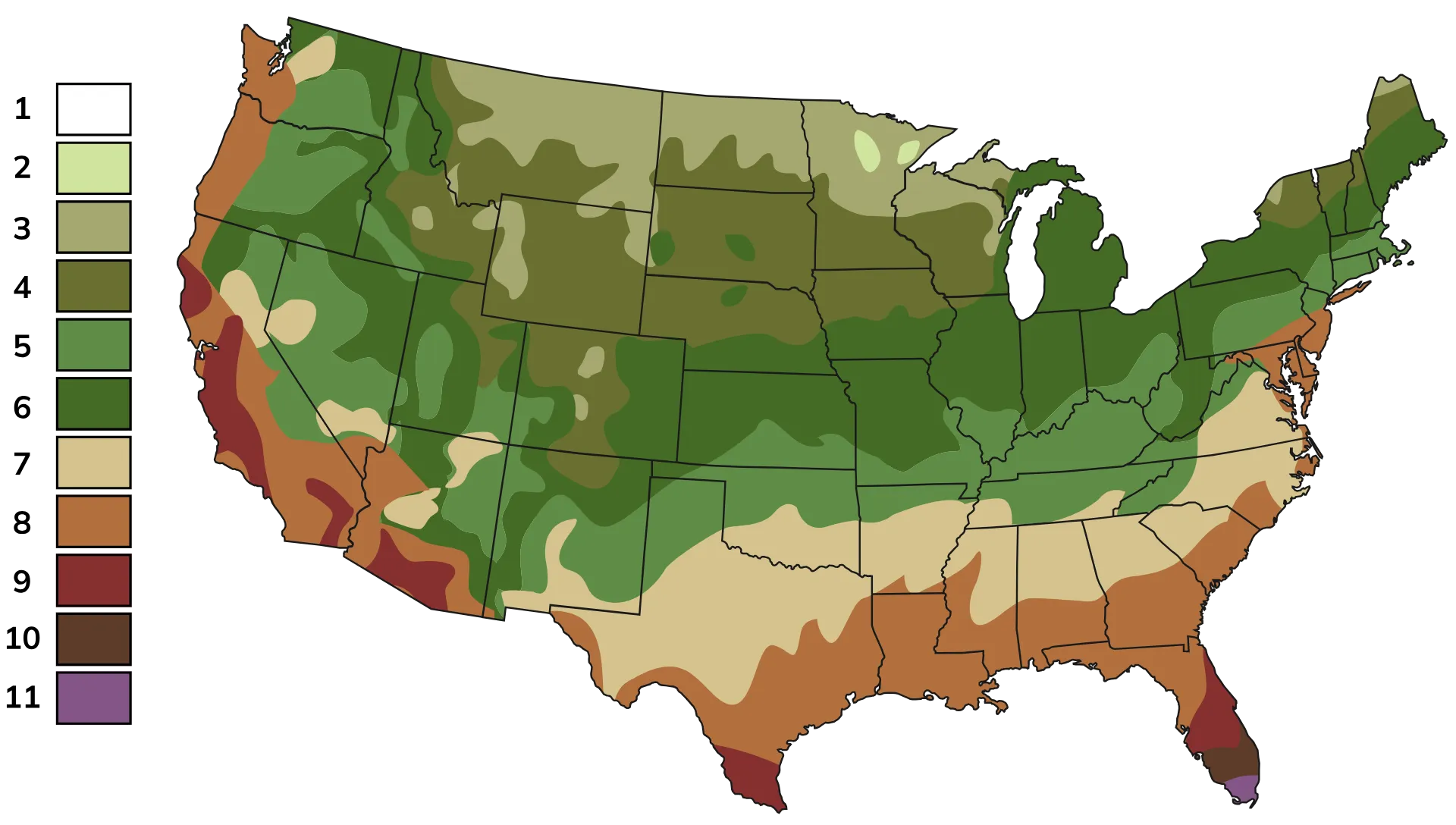
Cities in the north, like Dalton and Marietta, are in zones 6a to 7a. This means you need to plant grass seeds that can withstand colder temperatures. On the other hand, southern cities, like Albany and Valdosta, are located in zones 8a to 9a and will require homeowners to plant drought-resistant seeds in their yards instead.
Due to the wide range of zones in different areas of the state, it’s possible to grow cool- and warm-season grasses in Georgia.
Cool-Season Grasses: Ideal for Northern Georgia (Transition Zone)
Cool-season grass types thrive in areas with temperatures ranging between $60-75^\circ \text{F}$. They provide a lush green appearance on your lawn even if it gets chilly, and most of these varieties are hearty enough to maintain their color even during moderate, early summer temperatures. They typically go dormant or struggle in Georgia’s intense summer heat.
When planting cool-season grass seeds, make sure that there are approximately 45 days left before the first fall frost. The soil temperatures during this season (reaching $50-60^\circ \text{F}$) allow the seeds to germinate properly. Fall is the best time for seeding.
To keep these grasses at their peak conditions, you need to maintain them at a mowing height of three to four inches. Also, treat your grass with spot treatments if you see weeds growing on your turf. Finally, make it a point to fertilize cool-season grasses six weeks before the first frost.
Here are a few cool-season grasses that fit the bill, if you live in a cooler part of Georgia:
Kentucky Bluegrass
Kentucky bluegrass is a boat-shaped leaf with a dark green color. It can tolerate heavy use and traffic and has strong resistance to summer dormancy.
Unlike other cool-season grasses, this grass type establishes easily but germinates slowly. However, it experiences a growth spurt during the summer.

If you’re looking for a grass that adapts well to any condition and grows in either partial shade or full sun, you can’t go wrong with Kentucky bluegrass.
Perennial Ryegrass
People who live in coastal areas and experience moderate temperatures year-long typically grow perennial ryegrass. It germinates quickly to help you achieve a beautiful pale grass color for your lawn. The grass also has the best tolerance for wear and tear and high traffic among cool-season grasses.
Unlike other grasses, perennial ryegrass is a bunching grass that grows in clumps and features vertical shoots called tillers. In Georgia, it is often used for winter overseeding to provide green color while warm-season grasses are dormant.
Tall Fescue
Tall fescue has wide leaf blades that have the same size as their veins. Home lawns and even recreation areas like golf courses and athletic fields grow this grass type. It’s considered the most heat-tolerant cool-season grass.
Compared to other types of fescue, tall fescue grows much faster — it gains two inches a week during the fall season — and has a much darker color and denser growth. Tall fescue works best on its own, rather than in a blend, for establishing a year-round lawn in the northern part of the state.
Warm-Season Grasses: Best for Central and Southern Georgia
These types of lawn grasses thrive in temperatures over $75^\circ \text{F}$. During winter, most warm-season grasses turn brown but that doesn’t mean they’re dead. Warm-season lawns will get back their green color in the spring. The summertime can cause them to undergo summer dormancy. If this happens, revive them through consistent watering.
The only other time warm-season grasses need water is if their blades curl up and become narrow. While they *can* survive without water, they’ll still turn brown. Consistent watering is crucial for color, but most are highly drought-resistant once established.
Plant warm-season lawns in late spring when the soil temperature is around $65^\circ \text{F}$. It’s ideal to use a lawn starter fertilizer on them to help aid their germination and growth. You can also fertilize them once they’ve turned winter after wintertime.
Below are the different warm-season grasses you can plant on your lawns:
Bermuda Grass
Bermudagrass has short flat leaves and can grow as high as 16 inches tall. They grow into a dense turf for your lawn because its stems, also known as stolons, grow around the surface.

For this reason, bermudagrass grows the fastest of the grass types. On the downside, containing bermuda grass can be a challenge.
Otherwise, bermudagrass is not only the toughest among warm-season grasses but can also recover faster than the rest. It is resistant to diseases and tolerant to full sun, making it the perfect grass to grow on Georgia lawns, especially those with high foot traffic.
Carpet Grass
Carpet grass is another stoloniferous warm-season grass that has two-edge runners that grow wide light green leaves and rounded tips. To produce a dense turf with these grass seeds, you must fertilize it properly.
This grass type has fair shade tolerance but is not cold-, wear-, or drought-tolerant. Also, its fast growth requires frequent mowing to keep it at its optimum height, which is at $3/4$ to 2 inches. It performs best in damp, acidic soil found in some regions of Southern Georgia.
Centipedegrass
Centipedegrass is a turf-forming perennial grass that’s low-maintenance and heat-tolerant. It can grow in sandy soils that supply little to no nutrients, making it popular in the coastal plain.
Compared to other warm-season grasses, centipedegrass has a slow growth rate. It also doesn’t have high foot traffic tolerance and has a slow recovery when damaged.
On the upside, this grass type prevents weed from growing due to the dense turf it forms. This makes it a good blend for grass seeds prone to weeds.
Find Georgia Grass Seed to Grow In Your Yard
Finding the best grass seed to grow in Georgia should be much easier now that you have all the information you need to make a decision.
Among cool-season grasses, Kentucky bluegrass gives you more than just that deep green appearance. Its high tolerance and adaptability help you grow a sustainable lawn even during the cold months.
Zones conducive for warm-season grass will benefit from using Bermuda grass on their properties. It possesses all the characteristics that one needs for beautiful-looking turfgrass with little to no maintenance.
