Choosing the Right Cover Crop Kit to Build Soil or Smother Weeds
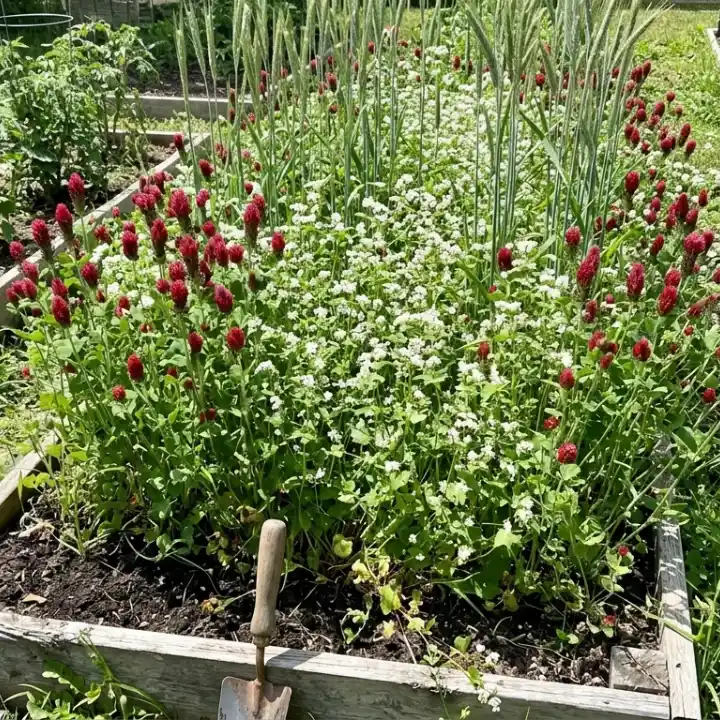
A bed that crusts hard after every rain and a bed that fills with pigweed by June need different seed. As such, it’s important to understand what problem you are trying to solve before buying a cover crop kit to avoid wasting a seeding.
A cover crop kit is simply a pre-bagged mix of two or more plant species, packaged to cover a specific plot size rather than a full acre.
Even if two different kits use some of the same seed, they can serve completely different purposes. For example, one kit might focus on adding nutrients to the soil and improving its structure, while another is designed to choke out weeds.
Iowa State puts the biomass needed to consistently reduce weed establishment at 9,000 pounds per acre [9]. That is the target a kit has to hit if it wants to keep weeds from taking over.
Which Problem Do You Actually Have?
Small growers usually turn to cover crops to solve one of three main problems. Each problem can be identified by looking at the warning signs in your soil and plants.
Soil compaction shows up as a hard layer you can feel. Try pushing a screwdriver or a metal wire into damp soil; if it suddenly stops, you’ve hit a compacted layer. If you dig down, you’ll likely see plant roots growing sideways instead of deep. Standing water that sticks around hours after it rains is another major red flag.
Low fertility shows up in your crops, not just the dirt. Plants grow slowly, stay pale, and remain small. Nutrient-hungry crops (like tomatoes or corn) stall out right in the middle of the growing season. A quick soil test will usually confirm your soil is low on organic matter or nitrogen.
Weed pressure is best identified by looking at timing. If a freshly cleared ground turns green with sprouts within just a few weeks, weeds are taking over. You’ll notice the exact same three or four weed species coming back every single year, and hand-weeding starts taking more and more of your time.
What Goes Into a Soil Builder Mix?
A soil builder blend contains species to complete three jobs at once: a legume to fix nitrogen, a brassica taproot to open a compacted layer, and a grass to add carbon and hold the surface.
Hairy vetch carries the nitrogen, and SARE reports that northeastern growers who plant it by mid-September can net 100 pounds of available nitrogen per acre by mid-May, with accumulation of 130 to 180 pounds per acre measured in Maryland trials [3]. Crimson clover fills the same slot further south, contributing 70 to 150 pounds of nitrogen per acre [4].
Forage radish works the hard layer, and its taproot can penetrate up to six feet. Radish stands in Michigan produced 8,000 pounds per acre of top growth, with below-ground biomass running as high as 3,700 pounds per acre [5].
Cereal rye supplies the carbon and the winter cover. SARE puts typical northeastern production at 3,000 to 4,000 pounds of dry matter per acre, and as much as 10,000 pounds per acre [1].
What Does a Weed Smother Mix Do Differently?
A smother mix is built for canopy speed and residue mass rather than for a long species list. Penn State notes that a planned mixture of a few complementary species, three to five, may provide the same cover crop services as a mixture carrying many more [7].
Rate and timing carry more of the result than diversity does. In an Iowa trial, rye seeded in September produced about 3,200 pounds per acre, well short of that threshold: common lambsquarters emergence fell 15 percent, while waterhemp density more than doubled [9]. Rye seeded in October there produced less than 500 pounds per acre and increased emergence of both species [9].
Seed date moves the same lever. In a New York study, oat plots planted on August 25 carried 39 percent fewer weed plants and one seventh the weed biomass of the control plots, while plots seeded two weeks later showed just 10 percent fewer weeds [2]. For weed suppression and erosion protection, Penn State puts cereal rye in the 45 to 90 pound per acre range [8].
How to Convert Kit Rates to a Bed or a Small Plot
Kit rates are printed per acre, and a bed is measured in square feet. These drilled monoculture rates convert to the plot scale:
- cereal rye, 60 to 120 pounds per acre, or 1.4 to 2.8 pounds per 1,000 square feet [1]
- oats, 60 to 75 pounds per acre, or 1.4 to 1.7 pounds per 1,000 square feet [11]
- hairy vetch, 15 to 20 pounds per acre, or 0.3 to 0.5 pounds per 1,000 square feet [3]
- crimson clover, 15 to 18 pounds per acre, or 0.3 to 0.4 pounds per 1,000 square feet [4]
- forage radish, 8 to 12 pounds per acre, or 0.2 to 0.3 pounds per 1,000 square feet [5]
Broadcasting onto a raked bed instead of drilling raises the rate, and SARE lists 90 to 160 pounds per acre for rye, 25 to 30 for hairy vetch, and 12 to 20 for radish [1][3][5].
Blending changes the arithmetic again. Penn State cuts grasses in a mixture to between half and one quarter of their monoculture rates, while legumes stay near their own [7]. In a mixture it caps forage radish at 2 to 3 pounds per acre and oats or cereal rye at 20 to 30 pounds per acre [7].
How Late in the Fall Is Too Late to Seed?
Every species in a kit has its own cutoff, counted back from the average first frost where you garden:
- oats, at least 40 to 60 days before the first killing frost [2]
- hairy vetch, 30 to 45 days before a killing frost [3]
- crimson clover, six to eight weeks before the average first frost date [4]
- forage radish, about four weeks before the average date of the first 28 degree freeze [5]
Seed past those dates and a stand can still come up, but it rarely reaches the mass that does the work.
How to Terminate a Cover Crop Without a Sprayer
Winter does part of the job for you. Oats winterkill in Zone 6 and colder and in much of Zone 7 [2], forage radish normally winterkills once air temperatures drop below 23 degrees for several nights running [5], and sustained cold below 18 degrees without snow cover usually kills Austrian winter pea [6].
Hairy vetch and cereal rye are the two that come back in spring. Vetch is winter hardy through Zone 4 and into Zone 3 with snow cover, though a severe freeze under 5 degrees may kill it on bare ground [3].
For the overwintering species, three tools work without chemicals: mowing at flowering and leaving the residue in place, rolling and crimping rye once it heads, or tarping the bed with opaque plastic for several weeks. Iowa State advises delaying rye termination past mid-May so that biomass is maximized for the most persistent weed suppression [10].
Name the problem before you buy the bag. A bed that stays pale and slow needs the legume and taproot side of the catalog, and a bed that greens over weeks after clearing needs mass and canopy speed. Nature’s Seed sizes its cover crop kits by plot rather than by the acre. If fertility and structure are the limit, start with the Soil Builder kit, and if the weed seedbank is, start with the Weed Smother kit on the cover crop seed pages.
Sources
[1] Sustainable Agriculture Research and Education, Cereal Rye, Managing Cover Crops Profitably, sare.org/publications/managing-cover-crops-profitably/nonlegume-cover-crops/cereal-rye
[2] Sustainable Agriculture Research and Education, Oats, Managing Cover Crops Profitably, sare.org/publications/managing-cover-crops-profitably/nonlegume-cover-crops/oats
[3] Sustainable Agriculture Research and Education, Hairy Vetch, Managing Cover Crops Profitably, sare.org/publications/managing-cover-crops-profitably/legume-cover-crops/hairy-vetch
[4] Sustainable Agriculture Research and Education, Crimson Clover, Managing Cover Crops Profitably, sare.org/publications/managing-cover-crops-profitably/legume-cover-crops/crimson-clover
[5] Sustainable Agriculture Research and Education, Brassicas and Mustards, Managing Cover Crops Profitably, sare.org/publications/managing-cover-crops-profitably/nonlegume-cover-crops/brassicas-and-mustards
[6] Sustainable Agriculture Research and Education, Field Peas, Managing Cover Crops Profitably, sare.org/publications/managing-cover-crops-profitably/legume-cover-crops/field-peas
[7] The Pennsylvania State University Extension, Making the Most of Mixtures, Considerations for Winter Cover Crops, extension.psu.edu/making-the-most-of-mixtures-considerations-for-winter-cover-crops
[8] The Pennsylvania State University Extension, Cover Crop Seeding Rates, extension.psu.edu/cover-crop-seeding-rates
[9] Iowa State University Extension and Outreach, Will a cereal rye cover crop suppress your weeds, crops.extension.iastate.edu/encyclopedia/will-cereal-rye-cover-crop-suppress-your-weeds
[10] Iowa State University Extension and Outreach, Weed Suppression With Cover Crops, It’s All About Biomass, crops.extension.iastate.edu/post/weed-suppression-cover-crops-its-all-about-biomass
[11] Iowa State University Extension and Outreach, Oats as a cover crop, crops.extension.iastate.edu/encyclopedia/oats-cover-crop