Choosing The Right Cover Crop Species Based on Soil Test Results
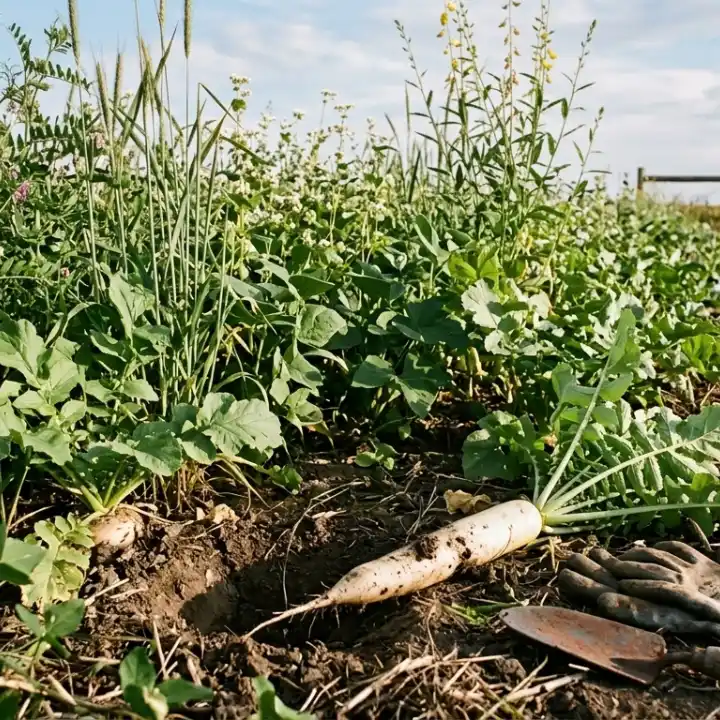
A soil test comes back as a column of numbers and no advice about what to plant. Four of those lines decide which cover crop species belong on the field, and the rest can wait.
Organic matter is the number most growers are chasing, and it moves at the pace of a decade rather than a season. A soil at 3 percent organic matter might only rise to 4 percent after a decade or more of soil building [1]. What goes in the drill this fall still matters, because the species mix sets how fast that line moves.
What Should You Read First on a Soil Test?
Organic matter percent is the baseline you retest against. Record it alongside the sampling depth, because the two numbers only mean something as a pair. In Pennsylvania, 2 to 5 percent is the working target for field soils, and organic matter builds faster under a high tunnel than in the open field [4].
pH comes next, and it rules species in or out faster than any other line. Legumes fix nitrogen through rhizobium, the soil bacteria that build nodules on their roots, and that partnership fails on acid ground. Cereals and brassicas tolerate a wider band, so a low pH field can still carry a cover crop while the lime does its slow work.
Phosphorus and potassium describe what a cover crop is recycling, not what it is adding. Roots pull those nutrients up from depth and park them in residue near the surface. A field short on potassium in October is still short on potassium in April.
Cation exchange capacity, or CEC, is the count of nutrient ions a soil can hold, and it mostly reports texture plus organic matter. Typical values run 1 to 5 meq per 100 grams in sand, 5 to 15 in loam, 15 to 30 in clay loam, and above 30 in clay [4].
A sandy field with low CEC leaks nutrients between rains. That is the argument for a fibrous rooted cereal that holds them in living tissue over winter.
Which Five Principles Should a Cover Crop Mix Serve?
Federal soil health guidance rests on five working principles, and a well built mix serves all of them at once:
- Keep the soil covered so rain lands on residue, not on bare ground
- Disturb the soil as little as the operation allows
- Keep living roots growing for as much of the year as you can
- Grow several plant families rather than one species repeated
- Bring livestock in where fence and water make it practical
One species can serve two or three of those principles on its own. A blend of a cereal, a legume, and a broadleaf serves all five for very little extra cost per acre.
How to Match a Species to the Problem the Numbers Name
Match the seed to the line on the report that looks worst:
- Low nitrogen on a field that gets no manure: legumes such as crimson clover, hairy vetch, or field peas
- Compaction and a shallow root zone: brassicas, which can root to six feet or more [8]
- Erosion, thin residue, and low organic matter: cereals such as rye, oats, or triticale
- A summer fallow gap in hot weather: warm season broadleaves such as buckwheat and sunn hemp
Of the functional groups, grasses give the highest average erosion protection, broadleaves come next, and legumes give the least while still counting for something [9]. Forage radish is the usual answer to a compacted layer, and some data support its taproot as a way to bio-till that layer open, meaning the root itself does the work a tillage pass would [9].
Which Cover Crops Feed Mycorrhizal Fungi?
Arbuscular mycorrhizal fungi, or AMF, are root fungi that trade phosphorus and water to a plant in exchange for sugar. Most cover crop species host them. Brassicas do not. Canola, radish, and the mustards sit in the non host column, and their root chemistry is antifungal [3].
That matters because AMF need a living root to persist through the winter. Colonization in the cash crop that follows is often higher after a mycorrhizal cover crop such as rye or oats than after canola or radish, or after a field left fallow [3]. A long bare fallow starves the same population that a straight brassica planting does.
The answer is a blend rather than a ban. Mixing a brassica with a mycorrhizal host, radish with oats for instance, may offset the reduction [3].
How to Set Rates and Termination Timing for a Blend
Monoculture rates are the starting point, and broadcast rates sit above drilled rates because seed to soil contact is worse when nothing buries the seed.
Cereal rye drills at 60 to 120 pounds per acre and broadcasts at 90 to 160, planted no deeper than 2 inches [6]. Crimson clover drills at 15 to 18 pounds and broadcasts at 22 to 30 [7]. Forage radish drills at 8 to 12 pounds and broadcasts at 12 to 20 [8].
Blending means cutting each of those rates back. Crimson clover in a mixture goes in at about two thirds of its normal rate, with the companion crop at one third to one half of its own [7].
Rye sown with a legume goes in at the lowest locally recommended rate, and one published pairing is 42 pounds of rye with 19 pounds of hairy vetch per acre [6].
Termination timing is the other lever, and it trades nitrogen against carbon. Kill the stand early and the nitrogen stays easy for the next crop to reach, while the residue stays thin. Let a cereal head out and you gain cover and carbon, with a wider carbon to nitrogen ratio that ties nitrogen up for a while.
How Long Before the Test Shows More Organic Matter?
Retest on the same schedule, the same depth, and the same season. Routine sampling is often done at a 6 inch depth, in the fall after harvest or in the spring before field work, and repeated every 2 to 4 years [5]. Change any one of those and the comparison stops meaning much.
Expect the physical changes first. Aggregation and infiltration, the rate at which rain soaks in instead of running off, can show up in the first season, while a measurable gain in organic matter takes several years of continuous cover [1].
A five year clover trial in California raised organic matter in the top 2 inches from 1.3 to 2.6 percent, and only from 1.0 to 1.2 percent in the 2 to 6 inch layer [2]. Pooled across many experiments, cover crops raised organic matter about 8.5 percent over the starting level [2].
Pull the four numbers, name the worst one, and pick the functional group that answers it. If your report points at one clear problem, the cover crop mixes sorted by goal at Nature’s Seed cover the common ones. Send the report in and a species shortlist comes back instead of a catalog.
Sources
- SARE. Building Soil Fertility and Tilth with Cover Crops
- SARE. Cover Crops, Building Soils for Better Crops
- Penn State Extension. Using Cover Crops to Direct the Soil Microbiome
- Penn State Extension. High Tunnel Soil Test Report
- Iowa State University Extension. A Recipe for Success with Soil Sampling
- SARE. Cereal Rye
- SARE. Crimson Clover
- SARE. Brassicas and Mustards
- Penn State Extension. Cover Crop Species Selection