
Quality Highlights
| Every Seed Grows We don't pad bags with dead seed or filler. What's in the bag is what grows in your yard. | |
| Independently Tested, Every Batch Each lot is tested by a third-party lab for germination and purity before it ships to you. | |
| Grown on American Farms Our seed comes direct from U.S. growers we know personally — not a middleman warehouse. | |
| Clean Seed, No Shortcuts No coatings to inflate weight, no GMOs, no cheap filler species. Just seed. |
Free shipping on all orders under 125 lbs!
What is Texas Pollinator Wildflower Mix?
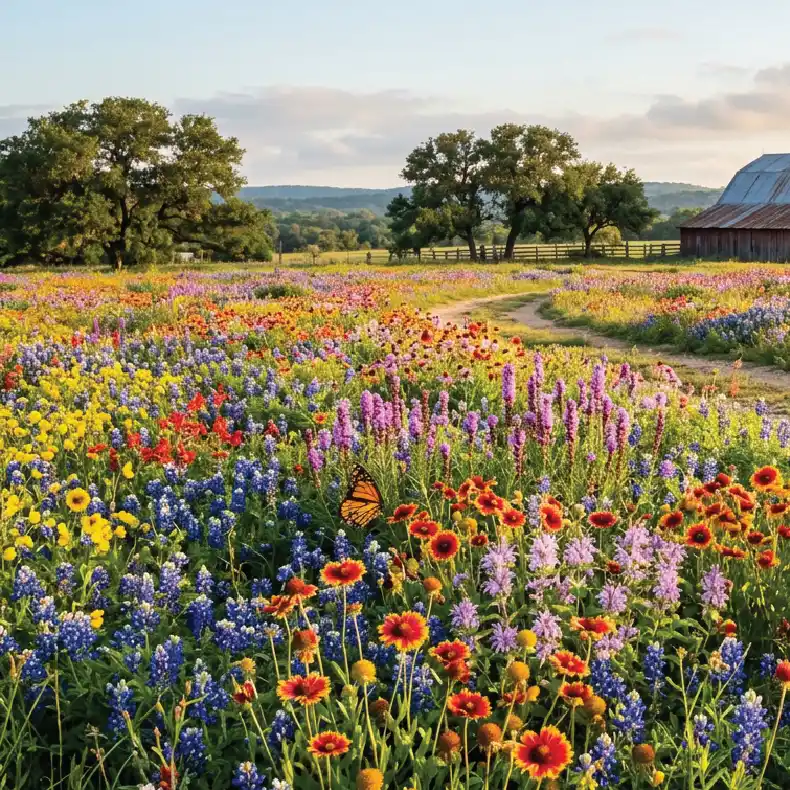
An 8-species native wildflower blend built specifically for Texas pollinators. Includes Butterfly Milkweed for Monarchs, Spiked Gayfeather for native bees, Scarlet Sage for hummingbirds, and a full sequence of nectar plants blooming from March through October across all Texas soil types.
What's in This Mix
Tiered purple whorls with a citrus fragrance that’s irresistible to long-tongued bees and hummingbirds.
Long-blooming perennial whose nectar-rich daisy heads are a magnet for butterflies, bees, and beneficial insects.
Deep blue spring bloomer that provides early-season nectar when pollinators need it most.
Vivid red tubular flowers designed for hummingbirds and long-tongued bees — blooms spring through first frost.
Low-growing legume with bright yellow flowers that attract native bees and fix nitrogen to enrich the soil.
Specifications
Seeding Specs
Establishment Specs
Why Choose This Seed?
Three Pollinator Guilds in One Mix
This mix targets three distinct pollinator groups. Butterfly Milkweed is the Monarch larval host — the only genus caterpillars can eat. Spiked Gayfeather and Lemon Beebalm are top-tier native bee plants. Scarlet Sage is a dedicated hummingbird attractor with tubular red flowers. Indian Blanket and Purple Coneflower serve as generalist nectar sources for all pollinator types. One mix, three guilds.
Designed for Texas Pollinators, Not a Generic Mix
Every species in this blend is native to or well-adapted for Texas conditions. The composition targets specific pollinator needs: Lemon Beebalm at 15% for native bees, Indian Blanket at 18% for butterflies, Scarlet Sage at 10% for hummingbirds. This is not a repackaged national pollinator mix — it is built around species that evolved alongside Texas pollinator populations and bloom when Texas pollinators need them.
March Through October Coverage
Pollinator habitat fails when it only blooms for one season. This mix is sequenced for continuous nectar availability. Texas Bluebonnet opens the season in March. Lemon Beebalm, Indian Blanket, and Scarlet Sage carry through spring and summer. Purple Coneflower and Spiked Gayfeather sustain through summer heat. Partridge Pea adds late-summer resources. The result is unbroken pollinator forage from March through October.
Monarch Migration Support
Texas sits on the Central Monarch Flyway — the primary spring and fall migration corridor for Monarch butterflies. Butterfly Milkweed (Asclepias tuberosa) at 12% is the larval host plant — the only genus Monarch caterpillars can feed on. Indian Blanket, Purple Coneflower, and Spiked Gayfeather provide critical nectar for adult Monarchs during migration. Partridge Pea hosts Sulphur butterflies as a bonus.
Certified Pollinator Habitat Potential
Plantings using this mix can qualify for pollinator habitat certification programs including Monarch Watch Waystation, Xerces Society Pollinator Habitat, and National Wildlife Federation Certified Wildlife Habitat. These programs require specific native host plants and sequential bloom — this mix meets those criteria.
How to Plant Texas Pollinator Wildflower Mix
Soil Prep
Choose a full-sun site with well-drained soil. Remove existing vegetation by mowing short or light raking. Do not deep-till — this brings up dormant weed seeds. Do not add fertilizer or compost — native wildflowers perform better in lean soil. Texas limestone, blackland clay, and sandy soils all work if drainage is adequate.
Seeding
Broadcast seed at 0.5 lb per 1,000 sq ft. Mix seed with dry sand at a 4:1 ratio for even distribution. Lightly rake to press seeds into the soil surface — no deeper than 1/4 inch. Roll or tamp for firm seed-to-soil contact. Water lightly after seeding.
Establishing
Water lightly every 2-3 days for the first 3-4 weeks if no rain occurs. Most seeds germinate within 10-20 days after fall planting. Milkweed and Liatris seeds may take longer — be patient. Weed by hand during establishment to reduce competition around young seedlings.
Ongoing Care
Once established, supplemental water is rarely needed except during severe drought. Do not mow until late summer after seed pods have dried and shattered. Milkweed and Liatris are perennial and return from established root systems. Do not cut milkweed during the growing season. Scarlet Sage self-seeds readily. Year 2+ displays are typically denser and more colorful.
Helpful Resources
Best Grass Seed for Texas
Wildflower Buffer Strips for Water Quality
Questions & Answers
Monarch butterflies require milkweed (Asclepias species) as their sole larval host plant. This mix includes Butterfly Milkweed (Asclepias tuberosa) at 12%. Adult Monarchs also need nectar plants like Indian Blanket, Purple Coneflower, and Spiked Gayfeather, all included in this mix.
September through early November is optimal. Fall planting gives seeds natural cold stratification through winter and positions them for spring germination. October is the sweet spot across most of Texas.
Eight species: Indian Blanket (18%), Texas Bluebonnet (15%), Lemon Beebalm (15%), Butterfly Milkweed (12%), Purple Coneflower (12%), Spiked Gayfeather (10%), Scarlet Sage (10%), and Partridge Pea (8%). The mix targets bees, butterflies, and hummingbirds with sequential bloom from March through October.
Yes. Scarlet Sage (Salvia coccinea) at 10% is a dedicated hummingbird attractor — its tubular red flowers are shaped specifically for hummingbird feeding. Hummingbirds will also visit Indian Blanket and Lemon Beebalm for nectar.
Yes. Most native Texas pollinator plants require a minimum of 6 hours of direct sunlight, with 8+ hours producing the best bloom and nectar production. Partial shade significantly reduces flowering.
Yes. Plantings with native host plants and sequential bloom can qualify for Monarch Watch Waystation, Xerces Society Pollinator Habitat, and National Wildlife Federation Certified Wildlife Habitat designation.
Still Have Questions?
Our seed experts are ready to help you find the perfect seed for your project.
1-866-322-7300 Ask a Seed ExpertCustomer Reviews
See what real customers are saying. All reviews are collected and verified by Shopper Approved, an independent third party.
