
Quality Highlights
| Every Seed Grows We don't pad bags with dead seed or filler. What's in the bag is what grows in your yard. | |
| Independently Tested, Every Batch Each lot is tested by a third-party lab for germination and purity before it ships to you. | |
| Grown on American Farms Our seed comes direct from U.S. growers we know personally — not a middleman warehouse. | |
| Clean Seed, No Shortcuts No coatings to inflate weight, no GMOs, no cheap filler species. Just seed. |
Free shipping on all orders under 125 lbs!
What is Texas Native Wildflower Mix?
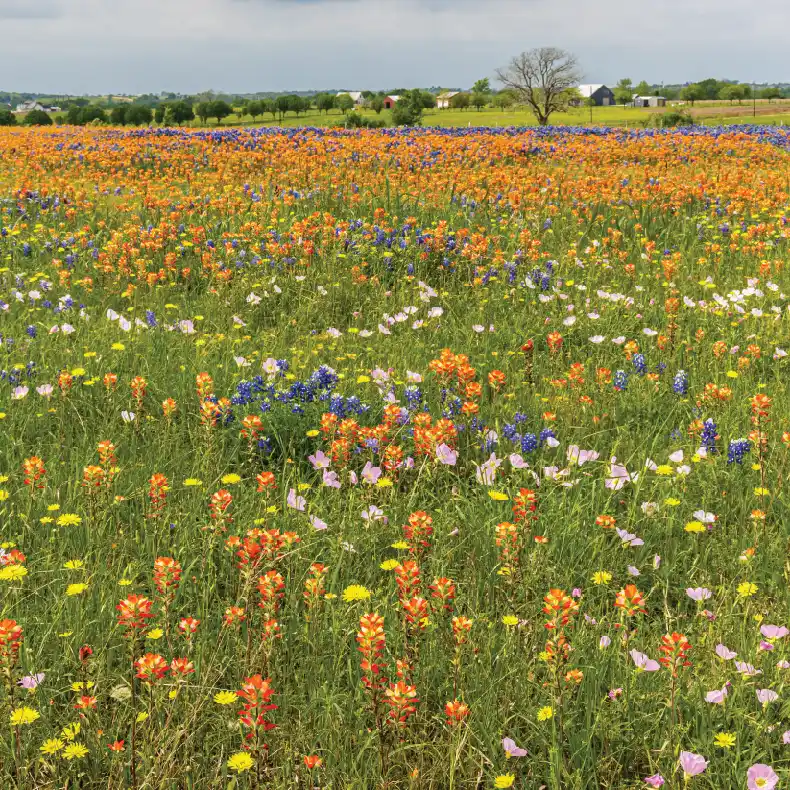
An 8-species wildflower blend anchored by Texas Bluebonnet at 22%, designed to recreate the iconic spring roadside display across Texas. This mix covers March through October with native annuals and perennials adapted to Texas limestone, blackland, and sandy soils.
What's in This Mix
The iconic Texas state flower — a nitrogen-fixing legume that enriches soil while painting landscapes in deep blue each spring.
Heat-loving annual with vivid red-and-yellow blooms that thrive in poor soils and attract pollinators all summer long.
Hardy native daisy that blooms reliably from spring through fall, providing long-season color and critical pollinator forage.
Cheerful yellow-and-crimson annual that naturalizes easily and fills open spaces with dense, carpet-like color.
Distinctive drooping-petal wildflower native to Texas prairies — extremely drought-tolerant once established.
Fragrant citrus-scented native that draws bees and butterflies while naturally deterring deer and rabbits.
Showy pink blooms that open in late afternoon, spreading readily to fill bare ground in full sun.
Nitrogen-fixing legume that improves soil fertility while providing important food for quail and songbirds.
Specifications
Seeding Specs
Establishment Specs
Why Choose This Seed?
Seven Months of Continuous Color
This mix is sequenced to bloom from March through October. Texas Bluebonnet and Evening Primrose lead the spring show. Indian Blanket, Black-Eyed Susan, and Mexican Hat take over for summer. Plains Coreopsis bridges spring and summer. Partridge Pea adds late-summer yellow. The result is continuous wildflower color across three full seasons from a single fall planting.
Designed for Texas, Not a Generic Mix
Every species in this blend is native to Texas. This is not a repackaged Southwest mix. The composition is built around the soils, rainfall patterns, and temperature swings specific to Texas — from Hill Country limestone to Blackland Prairie clay to East Texas sand. Competitors sell regional mixes covering 5-10 states. This one is built for one state.
Bluebonnet-Anchored at 22%
Texas Bluebonnet makes up the largest share of this mix. That means your spring display leads with the state flower — the species people recognize instantly. Indian Blanket at 20% and Black-Eyed Susan at 15% provide the summer backbone. The remaining species fill in with complementary colors, heights, and bloom times for a layered, natural meadow effect.
Pollinator Powerhouse
Every species in this mix supports pollinators. Lemon Beebalm at 10% is a top-tier native bee plant. Indian Blanket and Black-Eyed Susan attract butterflies. Bluebonnets support native bee populations. Partridge Pea fixes nitrogen and feeds Sulphur butterflies. Combined, this blend provides nectar and pollen across all three bloom seasons for a diverse pollinator community.
Low Maintenance Once Established
After the initial establishment period (fall seeding plus 3-4 weeks of light watering), this mix requires almost no ongoing care. Native species are adapted to Texas rainfall patterns and do not need fertilizer or irrigation once established. Allow seed pods to mature before mowing in late summer, and the annuals will reseed themselves for next year’s display.
How to Plant Texas Native Wildflower Mix
Soil Prep
Choose a site with full sun and good drainage. Remove existing vegetation by mowing short or light raking — do not deep-till, as this brings up dormant weed seeds. A thin layer of bare soil is ideal. Wildflowers prefer poor to moderate soil. Do not add fertilizer; nitrogen promotes weeds and foliage over flowers. Texas limestone, blackland clay, and sandy soils all work if drainage is adequate.
Seeding
Broadcast seed at 0.5 lb per 1,000 sq ft. Mix seed with dry sand at a 4:1 ratio (sand to seed) for more even distribution. Scatter evenly by hand or with a broadcast spreader. Lightly rake to press seeds into the soil surface — no deeper than 1/4 inch. Many wildflower seeds need light to germinate, so do not bury them. Roll or tamp the area for firm seed-to-soil contact.
Establishing
Water lightly every 2-3 days for the first 3-4 weeks if no rain occurs. Keep soil moist but never waterlogged. Most seeds germinate within 10-20 days after fall planting. Some species germinate immediately; others wait until spring warmth triggers them. By late fall you should see small seedlings forming. Do not mow or disturb the area through winter.
Ongoing Care
Once established, supplemental water is rarely needed except during severe drought. Allow the full bloom cycle to complete — do not mow until late summer after seed pods have dried and shattered. This ensures natural reseeding for the following year. Annual species return from dropped seed. Partridge Pea reseeds aggressively. Year 2 and beyond typically produce denser, more colorful displays than Year 1.
Helpful Resources
Best Grass Seed for Texas
Wildflower Buffer Strips for Water Quality
Questions & Answers
September through early November. Fall planting gives seeds a natural cold period through winter and positions them to germinate and bloom on schedule the following spring. October is optimal for most of Texas. Spring planting is possible but far less reliable — heat stress and inconsistent moisture reduce success rates significantly.
During the first 3-4 weeks, water lightly every 2-3 days if there is no rainfall. Keep the soil moist but not soggy. Once seedlings are 3-4 inches tall, reduce watering to deep soaking once a week if needed. After the first growing season, most Texas native wildflowers survive entirely on natural rainfall.
Eight Texas natives: Texas Bluebonnet (22%), Indian Blanket (20%), Black-Eyed Susan (15%), Plains Coreopsis (13%), Mexican Hat (10%), Lemon Beebalm (10%), Evening Primrose (5%), and Partridge Pea (5%). The mix is designed for sequential bloom from March through October.
Yes. At minimum, 6 hours of direct sunlight daily. Most Texas native wildflowers need 8 or more hours for full bloom potential. Partial shade reduces flowering significantly. Choose the sunniest site available — south or west-facing slopes are ideal.
Texas native wildflowers are adaptable to clay, sand, silt, and loam as long as drainage is adequate. They actually perform better in poor soil — rich, fertilized soil promotes weeds and foliage over flowers. Blackland Prairie clay, Edwards Plateau limestone, and East Texas sand all support native wildflowers. The only deal-breaker is standing water or chronic poor drainage.
Yes, if you let it. Allow the full bloom cycle to complete and seed pods to dry and shatter before mowing in late summer. The annual species — Indian Blanket, Plains Coreopsis, Lemon Beebalm, Evening Primrose, and Partridge Pea — return from dropped seed. Year 2 and beyond typically produce denser displays as the seed bank builds up in the soil.
Still Have Questions?
Our seed experts are ready to help you find the perfect seed for your project.
1-866-322-7300 Ask a Seed ExpertCustomer Reviews
See what real customers are saying. All reviews are collected and verified by Shopper Approved, an independent third party.
