
Quality Highlights
| Every Seed Grows We don't pad bags with dead seed or filler. What's in the bag is what grows in your yard. | |
| Independently Tested, Every Batch Each lot is tested by a third-party lab for germination and purity before it ships to you. | |
| Grown on American Farms Our seed comes direct from U.S. growers we know personally — not a middleman warehouse. | |
| Clean Seed, No Shortcuts No coatings to inflate weight, no GMOs, no cheap filler species. Just seed. |
Free shipping on all orders under 125 lbs!
Drummond Phlox Seeds
Phlox drummondii | SKU: W-PHDR
What is Drummond Phlox?
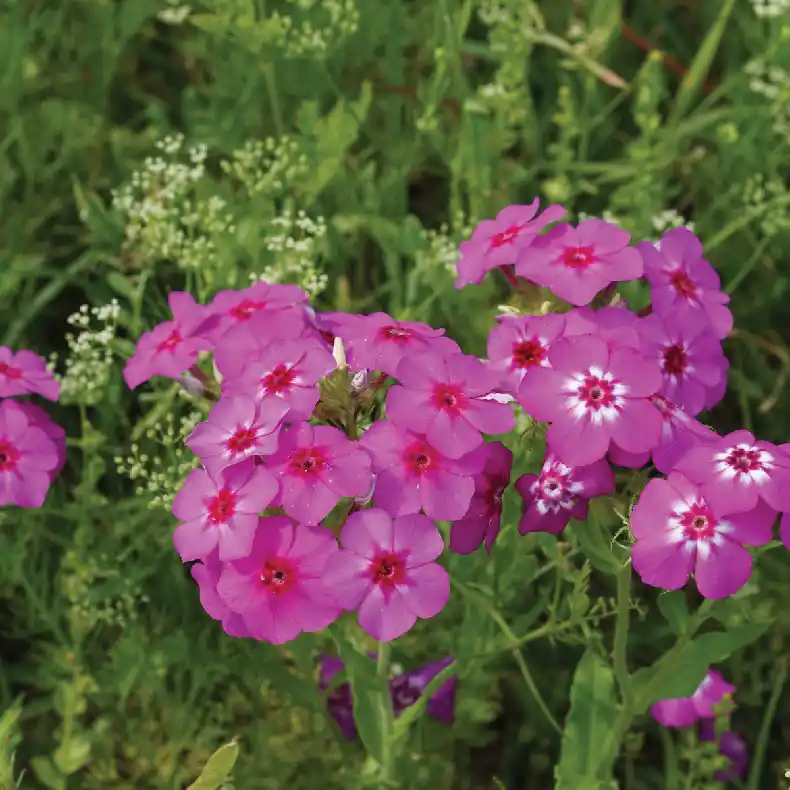
Drummond Phlox (Phlox drummondii) is the only annual phlox species native to Texas. Named after Scottish botanist Thomas Drummond who collected it in Texas in 1833, it produces clusters of fragrant flowers in red, pink, purple, white, and bicolor forms from March through May.
What's in This Mix
A Texas-native annual first discovered near Drummond, TX — produces dense clusters of vivid blooms in a range of colors and self-seeds reliably year after year.
Specifications
Seeding Specs
Establishment Specs
Why Choose This Seed?
The Only Annual Phlox Native to Texas
Of the roughly 70 phlox species in North America, Phlox drummondii is the only annual native to Texas. All other phlox species are perennials. This annual lifecycle means it germinates in fall, overwinters as a low rosette, and puts on a concentrated spring flower display — the same pattern as Texas bluebonnet. The result is a dense, colorful bloom that completes its entire show in one spring season.
Discovered in Texas, Named for Texas
In March 1833, Scottish botanist Thomas Drummond arrived at Velasco, Texas and spent 21 months collecting across the state from Galveston Island to the Edwards Plateau. He sent seeds of this unnamed phlox back to England, where it was formally described and named in his honor. Drummond died in Cuba in 1835, but his legacy lives on in this wildflower and about a dozen other plant species bearing his name.
Multicolor Spring Display
Drummond Phlox produces flowers in red, crimson, pink, rose, purple, lavender, white, and bicolor forms — often with contrasting eye centers. A single planting creates a patchwork of color as individual plants express different shades from the species’ natural genetic variation. This color range is not from hybridization — it is the natural diversity of wild Phlox drummondii populations in Texas.
Perfect Bluebonnet Companion
Drummond Phlox and Texas Bluebonnet follow identical lifecycle patterns — fall germination, winter rosette, spring bloom (March through May). They grow at similar heights and thrive in the same full-sun, well-drained Texas soils. Planted together, they create the classic multicolor Texas wildflower display. The pink and red phlox contrasts beautifully against blue and white bluebonnets.
Honest About Heat Limits
Drummond Phlox is a spring bloomer that declines in summer heat. Expect strong color from March through May. By June, plants begin to fade as temperatures rise. This is normal — it is a cool-season annual that puts all its energy into spring display. If you want summer color, pair it with warm-season wildflowers like Indian Blanket and Black-Eyed Susan.
How to Grow Drummond Phlox from Seed
Soil Prep
Choose a full-sun site with well-drained soil. Sandy, loamy, or even clay soils work if drainage is adequate. Remove existing vegetation and expose bare soil. Do not add fertilizer — Drummond Phlox performs well in lean soil. If planting with bluebonnets, prepare the site the same way — both species have identical site requirements.
Seeding
Broadcast seed at approximately 0.25 lb per 1,000 sq ft. Mix seed with dry sand for even distribution. Scatter evenly, then rake lightly to cover seeds to 1/16 to 1/8 inch depth. Unlike most wildflowers, Drummond Phlox seeds require DARKNESS to germinate — they must be lightly covered, not left on the surface. Press or roll the area firmly. Water lightly after seeding.
Establishing
Seeds germinate in 7-21 days when soil temperatures are 60-70 degrees F. Fall-sown seeds may germinate quickly and form small rosettes before winter. Other seeds may wait until spring warmth triggers them. Both patterns are normal. Once seedlings emerge, reduce watering. Drummond Phlox is moderately drought-tolerant once established. Weed by hand to reduce competition.
Ongoing Care
Allow the full spring bloom cycle to complete and seed pods to dry before any mowing or cleanup. Drummond Phlox will self-seed if allowed to drop seed naturally. Seed pods split open when mature. For consistent annual displays, supplement with fresh seed each fall. Do not fertilize. Once bloom fades in late spring, the plant dies naturally — this is the normal annual lifecycle, not a sign of failure.
Helpful Resources
Best Grass Seed for Texas
Wildflower Buffer Strips for Water Quality
Questions & Answers
Yes — they are ideal companions. Both are cool-season annuals native to Texas that follow the same lifecycle: fall germination, winter rosette, spring bloom (March through May). They thrive in the same soil types and sun exposure. The multicolor phlox contrasts beautifully with blue and white bluebonnets for a classic Texas wildflower display.
September through December for fall planting in Texas. October and November are optimal. Seeds germinate during cool weather and form low rosettes that overwinter. Spring bloom begins in March. Spring planting (February through March) is possible but produces weaker results. For spring planting, cold-stratify seeds in moist sand in the refrigerator for 60 days before sowing.
No. Drummond Phlox is a spring bloomer that declines significantly in summer heat. Expect strong color from March through May. Plants fade and die naturally by June as temperatures rise in Texas. This is normal annual behavior, not a problem. For summer wildflower color, plant warm-season species alongside phlox.
Red, crimson, pink, rose, purple, lavender, white, and bicolor forms with contrasting eye centers. This color range is the natural genetic variation of wild Phlox drummondii, not the result of hybridization. A single seed packet will produce a mix of colors from the species’ natural diversity.
Yes, Drummond Phlox self-seeds when allowed to complete its seed cycle. Let seed pods dry and split open naturally in late spring before mowing or clearing the area. Self-seeding is moderate — for a reliably dense display each year, supplement with additional fall-sown seed.
6-12 inches for wild-type plants, with some populations reaching 15-18 inches. The compact, bushy growth habit makes it an excellent front-of-border plant and ground-level wildflower in mixed meadow plantings. It is much shorter than most perennial phlox species.
Still Have Questions?
Our seed experts are ready to help you find the perfect seed for your project.
1-866-322-7300 Ask a Seed ExpertCustomer Reviews
See what real customers are saying. All reviews are collected and verified by Shopper Approved, an independent third party.
