
Seed Starter
High Phosphorus
| Every Seed Grows We don't pad bags with dead seed or filler. What's in the bag is what grows in your yard. | |
| Independently Tested, Every Batch Each lot is tested by a third-party lab for germination and purity before it ships to you. | |
| Grown on American Farms Our seed comes direct from U.S. growers we know personally — not a middleman warehouse. | |
| Clean Seed, No Shortcuts No coatings to inflate weight, no GMOs, no cheap filler species. Just seed. |
Free shipping on all orders under 125 lbs!
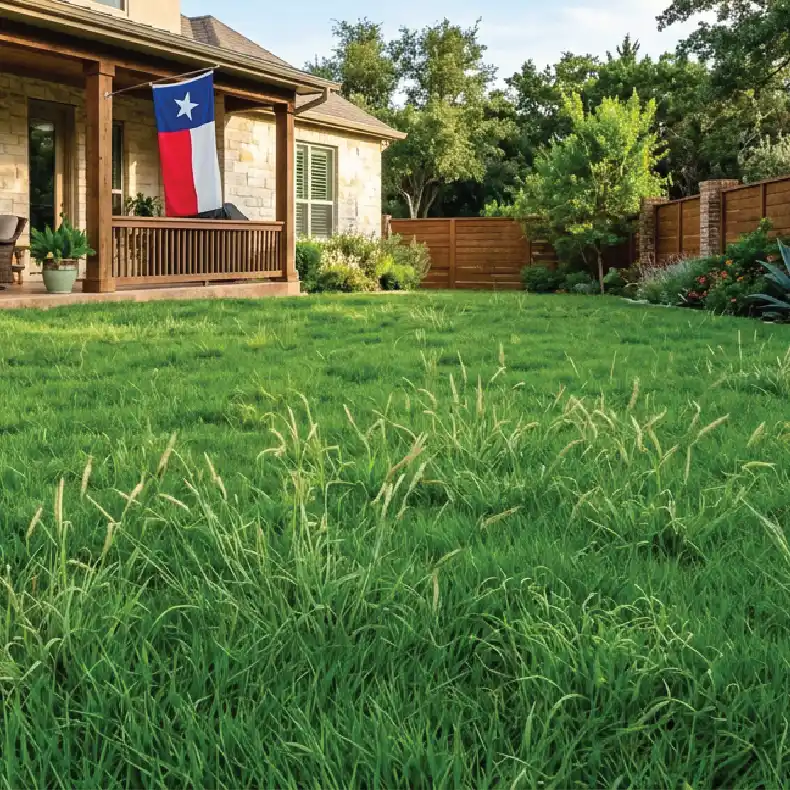
A 3-species native grass blend dominated by Buffalograss at 70%, designed to replace water-intensive turf in Central and West Texas. Uses 30-40% less water than Bermuda, needs no fertilizer once established, and tolerates Texas heat, drought, and alkaline soils.
The backbone of a Texas-tough lawn — once established, survives on rainfall alone and stays green with minimal mowing.
Fine-textured native bunchgrass that adds density and texture while tolerating extreme heat and drought.
Low-growing, mat-forming grass native to Texas rangelands that fills gaps between buffalo and grama for a denser turf.
Buffalograss uses approximately 30-40% less water than common Bermuda once established — documented by Texas A&M AgriLife Extension and multiple water utility studies. At 70% of this mix, Buffalograss is the dominant turf species. In a state where summer watering restrictions are increasingly common, this mix provides a lawn that survives and looks acceptable on rainfall alone across most of Central and West Texas.
All three species evolved in Texas soils without supplemental nutrition. Once established, this mix needs no fertilizer — in fact, excess nitrogen promotes weed invasion by stimulating non-native grasses. The result is a lawn that costs less to maintain per year than any conventional turf option.
This mix goes dormant in winter — typically November through March in Central Texas, shorter in South Texas, longer in the Panhandle. The lawn turns tan/brown during dormancy. This is normal for native warm-season grasses. If you need year-round green, this is not the right product. If you are willing to accept seasonal dormancy in exchange for a drought-proof, low-maintenance lawn the rest of the year, this mix delivers.
This mix performs best in USDA Zones 7-9 on alkaline to neutral soils — Hill Country limestone, Blackland Prairie clay, Rolling Plains, Edwards Plateau, and Panhandle soils. It does NOT perform well in East Texas (acidic sandy soils, high rainfall) or the Gulf Coast (high humidity, acidic soils). We are upfront about this limitation.
Buffalograss at 70% provides the primary turf surface — soft, fine-textured, and walkable. Blue Grama at 20% fills in thin spots with extreme drought tolerance and finer texture. Curly Mesquite at 10% handles the worst ground — rocky, caliche, and compacted soils where the other two struggle. Together, the three species cover more soil conditions than any single species could alone.
Remove existing vegetation completely — scalp, smother, or remove sod. Till or rake the top 1-2 inches to create a loose seedbed. Grade for drainage. Do NOT amend with fertilizer or compost. If overseeding an existing thin lawn, mow as short as possible and rough up bare spots with a metal rake.
Broadcast seed at 3-5 lb per 1,000 sq ft. Split the total seed into two halves and make two perpendicular passes. Rake lightly to cover seed to 1/4 to 1/2 inch depth. Roll or tamp firmly. Buffalograss seed has a fuzzy bur — mixing with dry sand helps distribution. Water immediately after seeding.
Water daily for the first 2-3 weeks. Buffalograss germinates in 14-21 days at soil temps above 60 degrees F. Blue Grama germinates slightly faster. After seedlings reach 1-2 inches, reduce watering gradually. Begin mowing when grass reaches 3-4 inches — set mower at 2-3 inches. First mow stimulates lateral spreading.
Once established, supplemental water is rarely needed in areas receiving 15+ inches of annual rainfall. Mow to 2-3 inches every 2-3 weeks. Do not fertilize. Do not apply pre-emergent herbicides during the first year. In winter, the lawn goes dormant — do not water or fertilize during dormancy. Green-up resumes in April-May.
In Central and West Texas on alkaline soils, yes. Buffalograss uses 30-40% less water, needs no fertilizer, and requires mowing only every 2-3 weeks. It does NOT work well in East Texas or Gulf Coast areas with acidic, sandy soils.
April through June, when soil temperatures are consistently above 60 degrees F. May is optimal for most of Texas. Fall planting is not recommended.
Curly Mesquite (Hilaria belangeri) is a low-growing native grass found across Central and West Texas on rocky, caliche, and limestone soils. It produces curling stolons that spread along the ground. At 10% of this mix, it fills in the harshest microsites where Buffalograss and Blue Grama struggle.
No. All species in this mix are warm-season grasses that go dormant in winter, turning tan or brown from November through March in Central Texas. If year-round green is a requirement, this is not the right product.
No. This mix is designed for Central and West Texas alkaline soils. East Texas and Gulf Coast areas have acidic, sandy soils and higher humidity that favor St. Augustine and Bermuda over buffalograss.
Several Texas municipalities offer WaterWise or water conservation rebates for replacing high-water turf with low-water alternatives. Austin, San Antonio, and other Central Texas cities have offered rebates up to $1 per square foot. Check with your local water provider.
Our seed experts are ready to help you find the perfect seed for your project.
1-866-322-7300 Ask a Seed ExpertSee what real customers are saying. All reviews are collected and verified by Shopper Approved, an independent third party.
