
Quality Highlights
| Every Seed Grows We don't pad bags with dead seed or filler. What's in the bag is what grows in your yard. | |
| Independently Tested, Every Batch Each lot is tested by a third-party lab for germination and purity before it ships to you. | |
| Grown on American Farms Our seed comes direct from U.S. growers we know personally — not a middleman warehouse. | |
| Clean Seed, No Shortcuts No coatings to inflate weight, no GMOs, no cheap filler species. Just seed. |
Free shipping on all orders under 125 lbs!
Texas Native Pasture Prairie Mix
SKU: PB-TXPR
Supported Species:
- Cattle
- Horse
What is Texas Native Prairie Mix?
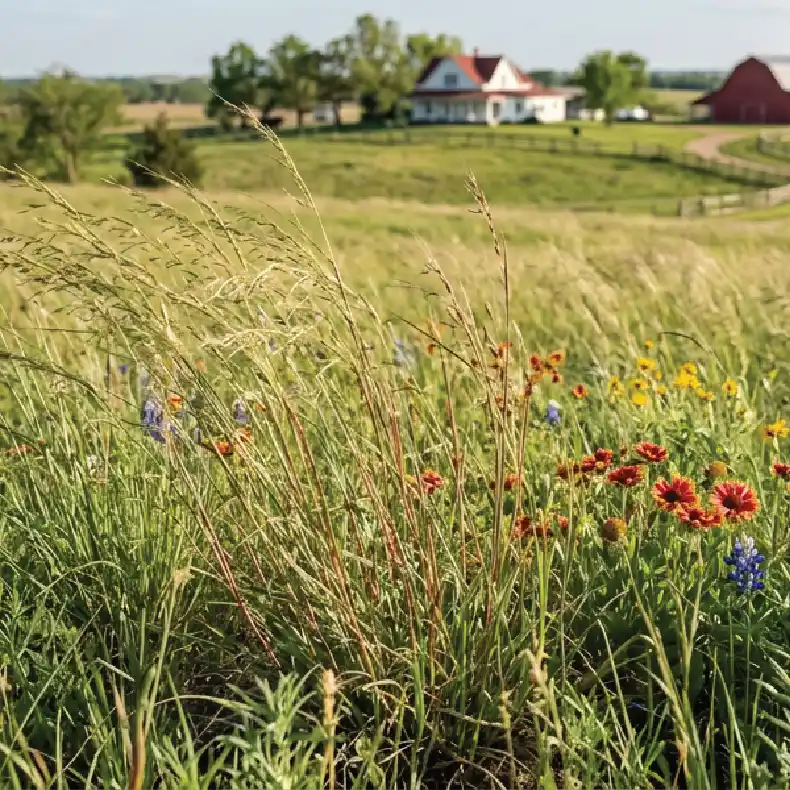
An 8-species blend of native grasses and wildflowers that recreates Texas prairie habitat. Anchored by Sideoats Grama (Texas state grass) at 35% and Little Bluestem at 25%, this grass-dominant mix establishes a self-sustaining prairie stand for rangeland restoration, conservation programs, and large-scale native landscape.
What's in This Mix
The official state grass of Texas — deep-rooted warm-season bunchgrass with excellent drought hardiness and erosion control.
Iconic prairie bunchgrass that turns brilliant copper-red in fall, providing year-round visual interest and wildlife cover.
Sod-forming native that knits the prairie together between bunchgrasses — survives extended drought on stored root reserves.
Tall, deep-rooted warm-season grass that anchors the mix with superior erosion control and wildlife nesting habitat.
Spring-blooming legume that adds a burst of blue color and fixes nitrogen to feed companion grasses naturally.
Sun-loving wildflower that provides warm-season color and pollinator forage between grass stands.
Delicate annual that seeds between grass clumps, adding yellow-and-red accents to the prairie floor.
Whimsical drooping-petal native that thrives in the dry calcareous soils typical of Texas hill country.
Specifications
Seeding Specs
Establishment Specs
Why Choose This Seed?
Anchored by Texas State Grass at 35%
Sideoats Grama was designated the Texas state grass in 1971. It makes up 35% of this mix — the largest single species by weight. Sideoats Grama establishes faster than most prairie grasses, tolerates a wide range of Texas soils from clay to limestone to sand, and provides the structural backbone that holds a prairie planting together while slower species establish around it.
Year 1 Is Ugly — And That Is Normal
Prairie restoration does not look like a wildflower meadow in Year 1. The first year is sparse, weedy, and often disappointing. Native grasses spend Year 1 building root systems that extend 4-8 feet deep — the aboveground growth is secondary. By Year 2, grass density increases noticeably. By Year 3, the prairie stand transforms. If you need instant beauty, plant wildflowers. If you want a permanent landscape that improves for decades, plant prairie.
85% Grass, 15% Wildflower
This mix is approximately 85% native grasses and 15% native wildflowers by weight. Sideoats Grama, Little Bluestem, Buffalograss, and Switchgrass form a multi-height grass matrix from 6 inches to 6 feet. The wildflowers — Bluebonnet, Indian Blanket, Plains Coreopsis, and Mexican Hat — provide color, pollinator habitat, and ecological diversity in the spaces between grass clumps.
TxDOT and Conservation Alignment
Every species in this mix appears on TxDOT’s approved revegetation species list and aligns with NRCS conservation planting recommendations for Texas ecoregions. This mix is appropriate for highway right-of-way restoration, USDA conservation program plantings (CRP, EQIP), ranch and rangeland improvement, and municipal natural area establishment. Seeding rates are specified in Pure Live Seed (PLS) per industry and agency standard.
Drought-Proof Once Established
Every grass species in this mix is rated for extreme drought tolerance. Sideoats Grama, Little Bluestem, and Buffalograss survived the 2011 Texas drought — the worst single-year drought in Texas recorded history — on rangeland with zero supplemental irrigation. Once root systems are established (Year 2+), supplemental watering is unnecessary in areas receiving 15+ inches of annual rainfall.
How to Plant Texas Native Prairie Mix
Soil Prep
For large areas: mow existing vegetation short and apply a burndown herbicide 2-4 weeks before seeding, or use prescribed fire if available. For small areas: remove vegetation by mowing and raking to expose bare soil. Do NOT deep-till unless compaction is severe. Do not fertilize.
Seeding
For acreage: drill-seed at 10 PLS lb per acre using a native grass drill set to 1/4-1/2 inch depth. For broadcast seeding, increase rate 50% (15 PLS lb/acre) and cultipack or roll immediately. For small areas: broadcast at 0.25 lb per 1,000 sq ft, mix with dry sand for even distribution, and rake lightly.
Establishing
Year 1 is primarily weed management. Mow weeds to 6-8 inches whenever they threaten to shade out young grass seedlings — typically 2-3 mowings. Do NOT mow below 6 inches. Do not apply broadleaf herbicide in Year 1 as it will kill wildflower seedlings. Be patient — the root development underground is the real work.
Ongoing Care
After Year 1, reduce mowing to once per year in late winter (February) or apply prescribed fire on a 3-5 year rotation. Do not fertilize. Do not irrigate except during severe multi-year drought. By Year 3, native grasses should dominate and weed pressure decreases dramatically.
Helpful Resources
Best Grass Seed for Texas
Native Grass Series: Great Plains
Questions & Answers
Expect a 3-year minimum. Year 1 is sparse and weedy while grasses build root systems. Year 2 shows noticeable grass density. Year 3+, the prairie stand matures with thick grass cover and integrated wildflower color.
Sideoats Grama (Bouteloua curtipendula), designated in 1971. It makes up 35% of this mix as the primary structural grass.
Eight species: Sideoats Grama (35%), Little Bluestem (25%), Buffalograss (15%), Switchgrass (10%), Texas Bluebonnet (5%), Indian Blanket (5%), Plains Coreopsis (3%), and Mexican Hat (2%). The mix is 85% grasses and 15% wildflowers.
Established prairie does not need regular mowing. A single annual mow in late winter (February) or prescribed fire on a 3-5 year rotation is the standard management approach.
This mix contains species commonly approved for USDA CRP and EQIP plantings in Texas. Specific requirements vary by county and practice code. Consult your local NRCS office before purchasing.
Native prairie grasses spend Year 1 building root systems 4-8 feet deep rather than producing aboveground biomass. Weeds temporarily fill the space. By Year 3, native grasses outcompete weeds through superior root competition.
Still Have Questions?
Our seed experts are ready to help you find the perfect seed for your project.
1-866-322-7300 Ask a Seed ExpertCustomer Reviews
See what real customers are saying. All reviews are collected and verified by Shopper Approved, an independent third party.
