
Quality Highlights
| Every Seed Grows We don't pad bags with dead seed or filler. What's in the bag is what grows in your yard. | |
| Independently Tested, Every Batch Each lot is tested by a third-party lab for germination and purity before it ships to you. | |
| Grown on American Farms Our seed comes direct from U.S. growers we know personally — not a middleman warehouse. | |
| Clean Seed, No Shortcuts No coatings to inflate weight, no GMOs, no cheap filler species. Just seed. |
Free shipping on all orders under 125 lbs!
Crimson Clover Cover Crop Seed
Trifolium incarnatum | SKU: PG-TRIN
What is Crimson Clover?
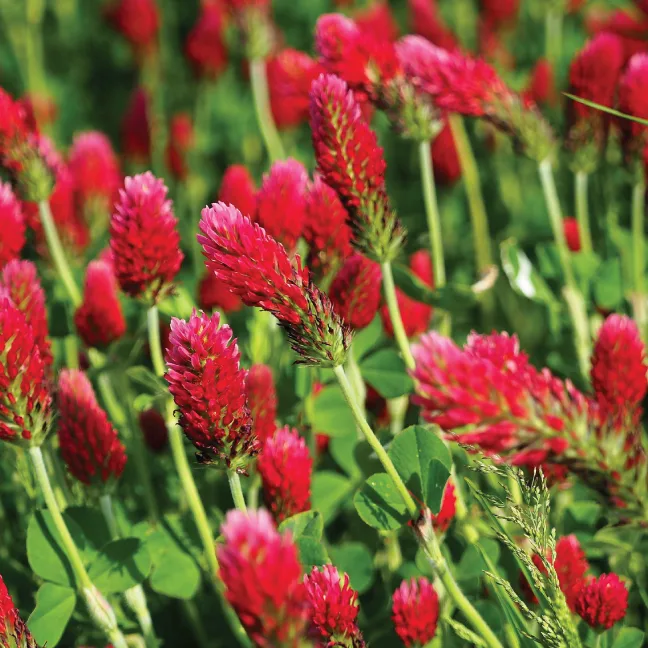
Crimson Clover (Trifolium incarnatum) is a winter annual legume that fixes 75-150 lbs of nitrogen per acre, produces dense biomass for weed suppression, and delivers the most visually striking bloom of any cover crop — tall crimson-red flower spikes in late spring. It is the earliest-blooming clover species, providing critical nectar when pollinators are emerging from winter with few other food sources available.
Specifications
Seeding Specs
Establishment Specs
Why Choose This Seed?
75-150 lbs Nitrogen Per Acre
Crimson clover fixes 75-150 lbs of nitrogen per acre when planted early and allowed to reach late bud stage before termination. That is enough to reduce or eliminate nitrogen fertilizer for the following crop. Peak nitrogen is locked in plant biomass and becomes available 4-8 weeks after termination as roots and residue decompose. Early termination (before bloom) reduces fixation by roughly 50 lbs/acre — let it bloom for maximum return. Seed MUST be inoculated with Rhizobium leguminosarum for nitrogen fixation to occur.
Earliest Blooming Clover — Critical Pollinator Timing
Crimson clover blooms 5-28 days earlier than any other clover species. In the South, blooms start early April. Mid-Atlantic, May. This timing fills a critical nectar gap when honeybees and native pollinators are building colony strength after winter with few other plants flowering. Beekeepers know crimson clover as one of the most dependable early-season honey crops. The dense crimson flower spikes are a magnet for honeybees, bumble bees, native bees, and butterflies.
Winter Annual — Plant Fall, Harvest Spring
Crimson clover is a winter annual in Zones 6-9. Plant in late summer or fall (August through October depending on region), and it establishes a rosette before winter. In spring it bolts, blooms, and produces biomass rapidly. Terminate at late bloom for maximum nitrogen, or let it go to seed for natural reseeding. In Zones 5 and colder, crimson clover can be spring-planted as a summer annual but produces less biomass and fixes less nitrogen than fall-planted stands.
Cover Crop Biomass and Weed Suppression
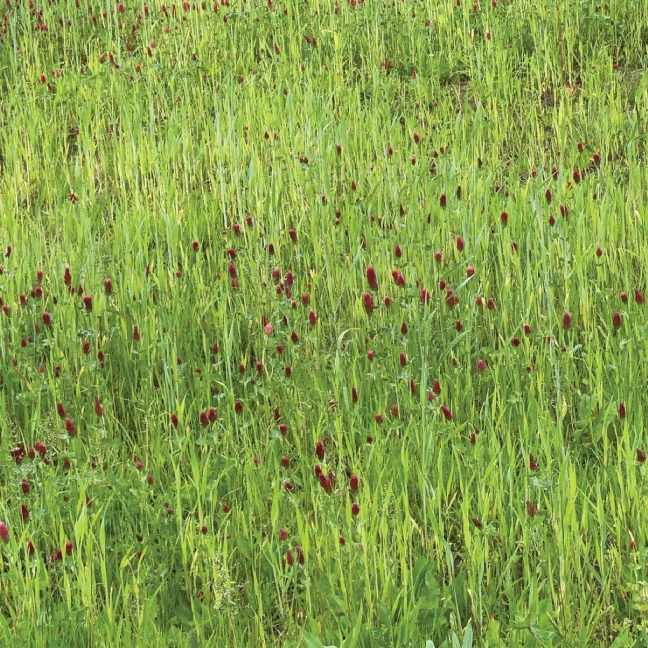
A well-established crimson clover stand produces 2,000-5,000 lbs of dry matter per acre. That biomass suppresses weeds during the cover crop phase and provides residue mulch after termination. The dense canopy shades out winter annuals. When mowed or rolled at bloom, the residue mat suppresses spring weed emergence for the following cash crop. It also makes excellent silage with high soluble carbohydrates.
Honest About Limitations
Crimson clover has real limitations and we will not oversell it. Winter hardiness: reliable in Zones 6-9 only. Zone 5 is borderline — winterkill is common without consistent snow cover. Zone 4 and colder: do not attempt fall planting. Soil drainage: requires well-drained soil; fails in waterlogged or heavy clay sites. Frost-seeding: does NOT frost-seed well — fall planting is the standard method. Spring planting: works but produces less biomass and lower nitrogen fixation than fall-planted stands.
How to Plant Crimson Clover
Inoculation
Crimson clover MUST be inoculated with Rhizobium leguminosarum bacteria for nitrogen fixation to occur. Without inoculation, the plants grow but do not fix nitrogen — defeating the primary purpose. If your seed is not pre-inoculated, purchase clover inoculant separately and apply immediately before planting. Inoculant is inexpensive and non-negotiable. If you have grown inoculated clover in the same field recently, residual bacteria may be present, but fresh inoculant is still recommended.
Seeding
Broadcast at 15-25 lbs per acre (0.5-0.75 lb per 1,000 sq ft). Drill at 8-18 lbs per acre for more efficient seed use. In mixtures with grass or small grains, reduce rate to 8-12 lbs/acre. Seed into a firm, well-prepared seedbed. If broadcasting, incorporate lightly by raking or dragging — do not leave seed sitting on the surface. Plant 1/4 to 1/2 inch deep. Press or roll for seed-to-soil contact.
Establishing
Seeds germinate in 7-21 days at optimal soil temperatures around 70°F. Fall-planted crimson clover forms a low rosette before winter and enters dormancy. In spring, rapid growth resumes with bolting and flowering by late spring. Keep newly seeded areas moist for the first 2-3 weeks if rainfall is insufficient. Once established, crimson clover requires no supplemental irrigation in most regions.
Termination
Terminate at late bloom stage for maximum nitrogen fixation — this is when N content peaks. Mow, roll/crimp, or incorporate. If you terminate too early (before bloom), you lose roughly 50 lbs/acre of potential nitrogen. Allow 4-8 weeks between termination and cash crop planting for nitrogen to become plant-available as residue decomposes. Alternatively, let crimson clover go to full seed set for natural reseeding — it will come back the following fall without replanting.
Helpful Resources
Clover Planting Guideline
Questions & Answers
75-150 lbs per acre is the realistic range when fall-planted and allowed to reach late bloom before termination. Under excellent conditions (early planting, good rainfall, full bloom), some studies report up to 200 lbs/acre. Early termination before bloom reduces fixation by approximately 50 lbs/acre. Thin stands fix less. Inoculation with Rhizobium bacteria is required.
Unreliably. Crimson clover is a dependable winter annual in Zones 6-9. In Zone 5, winterkill is common — especially in open winters without consistent snow cover. If you are in Zone 5 or colder, spring plant crimson clover as a summer annual (April-May) instead. Expect lower biomass and nitrogen fixation from spring plantings compared to fall.
Crimson clover is the earliest-blooming clover species. In the Deep South (Zone 8-9), blooms appear early April. Mid-Atlantic (Zone 7), May. Zone 6, late May to June. The bloom window is approximately 3 weeks. This early timing fills a critical nectar gap for pollinators emerging from winter.
Yes. Crimson clover has low bloat risk compared to other legumes — it is considered safe for grazing cattle, sheep, and goats. Forage quality is good: 16-24% crude protein in early growth, declining to 12-14% at full bloom. It makes excellent silage. The low bloat risk is a meaningful advantage over red clover and alfalfa for rotational grazing.
Yes, if allowed to reach full seed maturity. Let the seed heads dry and shatter naturally before mowing. The seeds will germinate the following fall when soil temperatures and moisture conditions are right. Reseeding cultivars like AU Sunup are specifically selected for this trait. For reliable reseeding, avoid mowing before seed set is complete.
AU Robin (early maturity, 2 weeks earlier than Dixie) and AU Sunrise (earliest available, blooms 5-18 days before AU Robin) are the current top varieties developed by Auburn University. Dixie is the standard full-season variety with wide adaptation. For corn rotations needing early termination, AU Sunrise or AU Robin are preferred. For maximum biomass, Dixie or Tibbee.
Still Have Questions?
Our seed experts are ready to help you find the perfect seed for your project.
1-866-322-7300 Ask a Seed ExpertCustomer Reviews
See what real customers are saying. All reviews are collected and verified by Shopper Approved, an independent third party.
