
Quality Highlights
| Every Seed Grows We don't pad bags with dead seed or filler. What's in the bag is what grows in your yard. | |
| Independently Tested, Every Batch Each lot is tested by a third-party lab for germination and purity before it ships to you. | |
| Grown on American Farms Our seed comes direct from U.S. growers we know personally — not a middleman warehouse. | |
| Clean Seed, No Shortcuts No coatings to inflate weight, no GMOs, no cheap filler species. Just seed. |
Free shipping on all orders under 125 lbs!
Mexican Primrose (Pinkladies)
Oenothera speciosa | SKU: W-OESP
What is Pink Evening Primrose?
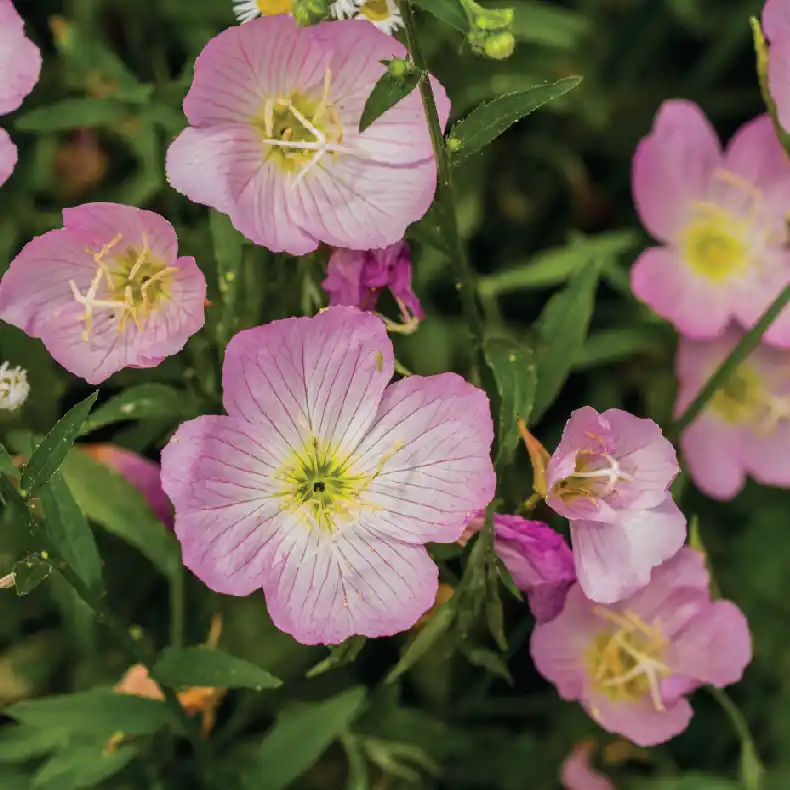
Pink Evening Primrose (Oenothera speciosa) is a native Texas wildflower that creates the massive pink carpets visible along Texas roadsides each spring. A true perennial that spreads by rhizomes and reseeding, it blooms from April through October in most of Texas.
What's in This Mix
A resilient Texas-native perennial with showy pink cup-shaped blooms that spreads vigorously to blanket sunny areas — thrives in heat, drought, and poor soils.
Specifications
Seeding Specs
Establishment Specs
Why Choose This Seed?
The Iconic Texas Pink Carpet
Every spring, pink evening primrose creates the sweeping roadside displays that Texans photograph alongside bluebonnets. Cup-shaped flowers open 1-2 inches wide in soft pink, fading to near-white as they age. In naturalized settings, colonies spread to form dense ground-covering drifts that bloom continuously from April through October in Central Texas.
Honest About Spreading
Pink evening primrose is aggressive. It spreads by underground rhizomes AND prolific self-seeding — both mechanisms working simultaneously. In moist, fertile soil (especially clay with irrigation), it will colonize adjacent garden beds. In dry, sandy, or poor soils, it forms attractive, more contained clumps. Plant it in meadows, xeriscapes, and naturalized areas. Do not plant it next to a manicured flower bed unless you want it there permanently.
Drought-Proof Native Perennial
Once established, pink evening primrose needs no supplemental water in most of Texas. Its rhizomatous root system accesses deep soil moisture. It thrives in the same sandy, poor soils where other ornamentals struggle. No fertilizer needed — in fact, fertilizer and irrigation make it MORE aggressive. Less input equals more controlled growth.
Not the Supplement Plant
Evening primrose oil (the dietary supplement) comes from Oenothera biennis — the Yellow Evening Primrose — NOT from this species. Pink Evening Primrose (O. speciosa) is purely ornamental with no documented medicinal uses. If you are looking for the supplement plant, we carry Yellow Evening Primrose (O. biennis) separately.
Bloom Timing Varies by Region
In South Texas, flowers may open in the morning and stay open through the day. In North Texas, flowers tend to open in the evening — classic evening primrose behavior. This geographic variation in bloom timing is a botanical feature of the species. Across all regions, flowers are pollinated by both day-flying bees and night-flying moths, and each flower lasts only one day before being replaced.
How to Grow Pink Evening Primrose from Seed
Soil Prep
Choose a full-sun site with well-drained soil. Sandy or poor soil is ideal — it produces attractive, more contained growth. Clay soil with irrigation produces aggressive spreading (plan accordingly). Remove existing vegetation and expose bare soil. Do NOT add fertilizer or compost. Pink evening primrose performs best in lean soil. If planting in a contained area, install underground barriers to 12 inches depth to limit rhizome spread.
Seeding
Press seeds onto the soil surface. Do NOT cover them — seeds require light to germinate. Scatter at approximately 1/3 lb per 1,000 sq ft, or place 2-3 seeds per spot for individual plantings. Mist gently after seeding to settle seeds into contact with the soil. For meadow plantings, mix seed with dry sand for even distribution.
Establishing
Keep the seeding area moist for the first 2-3 weeks. Seeds germinate in 15-30 days at soil temperatures of 65-75 degrees F. Once seedlings are established and actively growing, reduce watering gradually. Established plants are highly drought-tolerant and should not be irrigated regularly — overwatering promotes aggressive spread. Weed by hand during establishment.
Ongoing Care
Once established, pink evening primrose requires no maintenance in naturalized settings. To control spread: deadhead spent flowers before seeds mature, avoid watering and fertilizing established colonies, and cut rhizome runners at the colony edge with a spade once per year. The plant may go dormant during extreme summer heat and re-emerge with fall rains — this is normal. Returns reliably each spring as a true perennial.
Helpful Resources
Best Grass Seed for Texas
Wildflower Buffer Strips for Water Quality
Questions & Answers
Pink evening primrose is a native Texas wildflower, not technically invasive. However, it is aggressive — spreading by both rhizomes and self-seeding. In dry, poor soils it forms attractive clumps. In moist, fertile soils it spreads rapidly and can colonize adjacent garden beds. Plant it where spreading is acceptable (meadows, xeriscapes, roadsides) and avoid placing it next to manicured gardens.
Fall (October through November) is optimal for Texas, following the same timing as bluebonnets. Spring planting (February through March) is also effective. Press seeds onto the soil surface — they require light to germinate. Do not bury them. Germination takes 15-30 days at soil temperatures of 65-75 degrees F.
No. Evening primrose oil supplements come from Oenothera biennis (Yellow Evening Primrose), not from O. speciosa (Pink Evening Primrose). Pink evening primrose is purely ornamental with no documented medicinal uses. The two species are in the same genus but are different plants with different uses.
Deadhead spent flowers before seeds mature. Install underground barriers (corrugated fiberglass or metal edging) to 12 inches depth to block rhizome spread. Cut runners at the colony edge with a spade once per year. Avoid watering and fertilizing established colonies — both promote aggressive spread. In dry, lean soils, the plant naturally stays more contained.
Both — it varies by geographic location. In southern Texas populations, flowers tend to open in the morning and stay open through the day. In northern Texas and other northern parts of the range, flowers open in the evening (true to the evening primrose name). This geographic variation is a documented botanical feature of the species.
Pink evening primrose is a true perennial in USDA Zones 4-9. It returns from its rhizomatous root system year after year and also reseeds prolifically. Do not confuse it with Yellow Evening Primrose (O. biennis), which is a biennial that completes its lifecycle in two years.
Still Have Questions?
Our seed experts are ready to help you find the perfect seed for your project.
1-866-322-7300 Ask a Seed ExpertCustomer Reviews
See what real customers are saying. All reviews are collected and verified by Shopper Approved, an independent third party.
